Calling China “cashless” describes how most people pay; it does not make RMB notes invalid. Mobile wallets dominate everyday payment, while official policy keeps cash available as a backstop. For a traveler, the snag is usually change: a small shop may accept an RMB 100 note but be unable to break it, and an online booking cannot take a paper note at all.
My rule is simple: **phone first, small cash offline, physical card elsewhere**. That is a more resilient setup than trying to make one method cover every scene.
## RMB, yuan, CNY and “kuai” mean different parts of the same thing
| Term | What it means | Where you will see or hear it |
|---|---|---|
| Renminbi | The official name of mainland China's currency | Government and formal explanations |
| RMB | Common abbreviation for renminbi | Prices, travel guides and conversation |
| Yuan | The main unit of the currency | “This costs 30 yuan” |
| CNY | ISO currency code | Banks, card statements and exchange screens |
| ¥ | Currency symbol | Menus, tickets and checkout screens |
| Kuai (块) | Colloquial word for one yuan | Spoken Chinese: “30 kuai” |
If a hotel quotes **CNY 680**, an app shows **RMB 680**, and a cashier says **680 yuan**, they are naming the same amount. The symbol ¥ is also used for Japanese yen, so the country and checkout context still matter.
You normally cannot pay a mainland shop in US dollars, euros or Japanese yen. Exchange or withdraw RMB first.
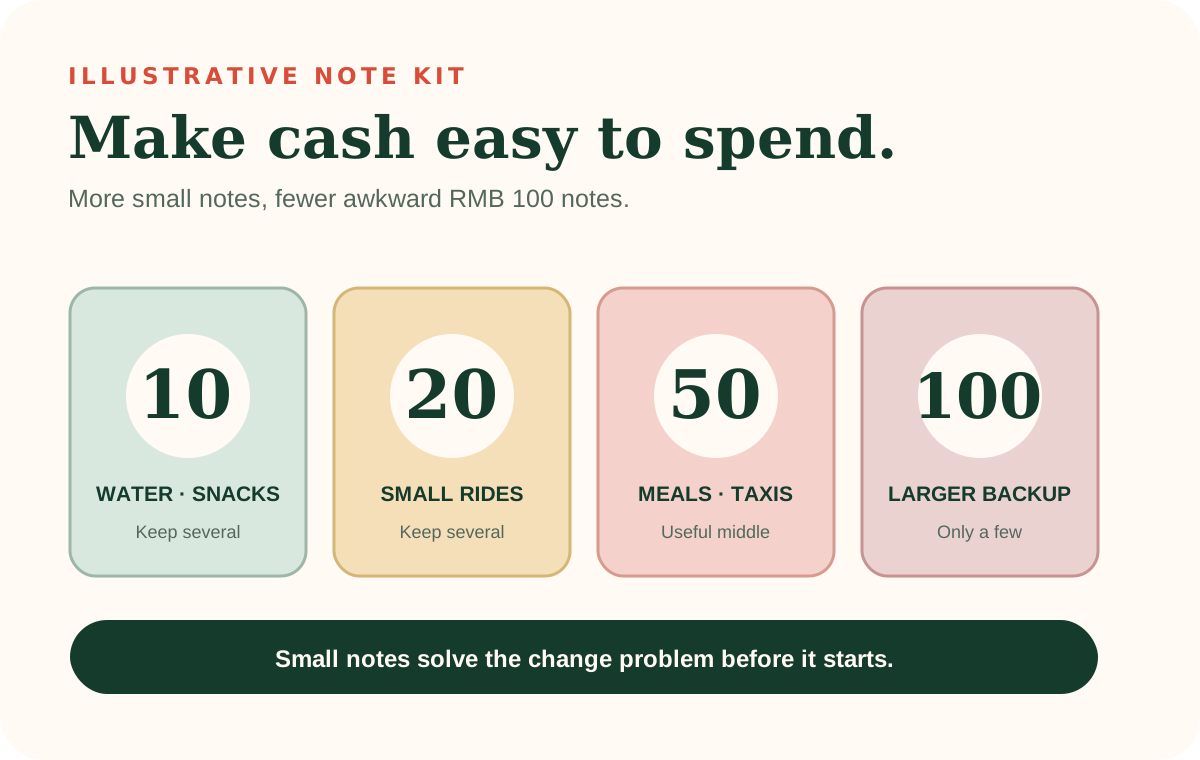
Cash mix This is a planning diagram, not a reproduction of Chinese banknotes. I prefer more RMB 10, 20 and 50 notes and only a few RMB 100 notes.
## Is cash still accepted in China?
Yes. The People's Bank of China describes cash as a basic and backstop payment method and says businesses should prepare change. China's official guide for overseas visitors also explains where visitors can exchange currency and withdraw RMB.
That does not make cash equally convenient everywhere.
- **Good cash scenes:** staffed ticket counters, convenience stores, restaurants, taxis that have change, street purchases and an offline emergency.
- **Awkward cash scenes:** app-only bookings, mini programs, bike rental, delivery and an unattended machine.
- **The usual friction:** the seller has no change for RMB 100, not that RMB itself is invalid.
If a merchant hesitates, ask whether a smaller note helps. Do not start a legal argument over a bottle of water when the practical fix is to break the note at a staffed chain store, hotel desk or bank.
Useful Chinese:
> 可以用现金吗?
> *Kěyǐ yòng xiànjīn ma?*
> Can I pay cash?
> 有零钱吗?
> *Yǒu língqián ma?*
> Do you have change?
## How much cash should a tourist carry?
There is no official tourist amount. **RMB 300–500 is my starting reserve for one adult on a short trip through major cities**, not a spending target and not a guarantee that it covers every taxi.
The calculator uses these editorial starting ranges:
| Trip pattern | Starting cash reserve |
|---|---:|
| Major cities, tested wallet, daytime arrival | RMB 300–500 |
| Cities plus day trips | RMB 500–800 |
| Remote or rural stops | RMB 800–1,200 |
It then adds RMB 100–200 for each extra traveler, RMB 200–300 for an untested wallet, RMB 400–600 when no wallet is set up, and RMB 200–400 for a late-night arrival. These additions are intentionally conservative planning buffers, not official guidance.
I would raise it when:
- the wallet has never completed a real merchant payment;
- the flight lands after the metro stops running;
- the route includes villages, remote scenic areas or long day trips;
- one person must cover a family or group;
- a known airport taxi, deposit or medical need is larger than the baseline.
I would not multiply the reserve blindly by every travel day. If mobile payment works, the cash should remain an offline runway. The planner above adjusts the starting range for the actual trip.
## Build a useful note mix
An envelope full of RMB 100 notes looks like a cash backup but behaves badly at a small counter. A more useful mix is:
- several RMB 10 and 20 notes for water, snacks and small purchases;
- RMB 50 notes for meals and short rides;
- only a few RMB 100 notes for a larger taxi or emergency;
- cash split between a daily pocket and a second secure place.
Coins and RMB 1 notes can be useful, but you do not need to engineer a perfect denomination set before flying. Get a workable mix, then use staffed purchases to collect smaller change.
## Where to get RMB
China's official 2025 guide lists three straightforward routes for overseas visitors: commercial banks, marked exchange outlets or machines at ports of entry, and ATMs that display the corresponding international card-network logo.
### Before departure
Arriving with a small amount removes one problem from the airport. The trade-off is that your home exchange counter may have a worse rate or only large notes. Ask for mixed denominations instead of accepting only RMB 100 notes.
### At the airport
Airport exchange counters and machines are convenient for a late arrival, not automatically the best value. Exchange enough to reach the hotel, then compare a bank or ATM later if you need more.
### At a bank counter
Bring your passport. Bank hours, supported currencies and procedures vary by branch. A staffed counter is also a sensible place to ask for smaller notes.
### At an ATM
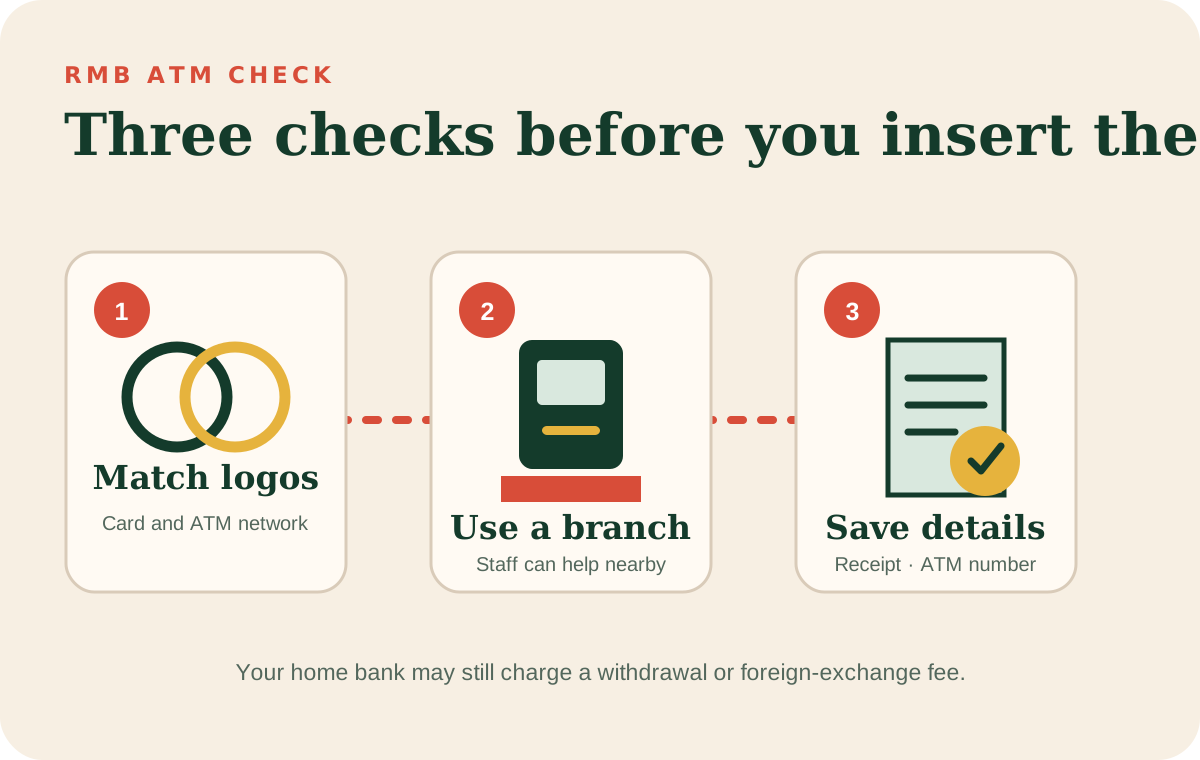
Match the network logo on the machine to the logo on your card. A Visa or Mastercard logo is more useful than assuming every ATM accepts every overseas card. Your home bank can still block cash withdrawals or charge its own fee.
ATM routine Match the network, choose a machine at a staffed bank branch when possible, and keep the receipt or ATM number until the transaction settles.
Before using the ATM:
1. Enable overseas cash withdrawals in your banking app.
2. Check the card PIN and the bank's daily limit.
3. Use a machine attached to an open branch when possible.
4. Note the ATM number and bank name before walking away.
5. If cash does not appear but the account is charged, keep the receipt and contact both banks.
If the machine retains the card, ask branch staff immediately, lock the card if recovery is uncertain, and switch to the independent backup bank.
## Which payment method fits each scene?
| Scene | First choice | Backup that actually changes the failure |
|---|---|---|
| Small restaurant or shop | Alipay or WeChat Pay merchant payment | Small RMB notes |
| International hotel | Physical card or mobile wallet | Card from another bank, then cash if accepted |
| Metro or staffed ticket desk | Transport QR, card or ticket machine | RMB cash at a service counter |
| Taxi | Wallet inside DiDi or merchant QR | Cash agreed before the ride ends |
| Online attraction booking | Supported wallet or overseas card | Different platform, card or staffed counter |
| Remote day trip | Wallet where data works | Larger mixed-note reserve |
Two apps linked to the same blocked card are not fully independent. Two cards stored only on one lost phone are not independent either. For the full failure sequence, use our [China payment backup plan](/en/pay/china-payment-backup/).
## A 15-minute setup before departure
1. Set up [Alipay with an overseas card](/en/pay/alipay-for-foreigners/) and finish identity checks.
2. Add a second wallet or at least a card from a different issuing bank.
3. Tell the banks you will travel and confirm how fraud alerts arrive.
4. Keep your home phone number reachable for SMS and account recovery.
5. Put RMB cash and the spare physical card somewhere other than the phone case.
6. Save the hotel address in Chinese before landing.
Binding a card is not the same as completing a payment. After arrival, test one low-value merchant purchase. If it works, stop treating your cash reserve as the main wallet.
## Can you travel in China using cash only?
You can cover many in-person purchases with RMB cash, but I would not design an independent trip around cash only. Train and attraction bookings, ride-hailing, bike rental, delivery and app-only discounts are much easier—or sometimes only possible—through digital payment.
Cash-only travel also creates a change problem and forces you to carry more money. I treat cash as a way to finish the next few hours when Alipay fails, not as a replacement for the wallet. For that job, it is excellent.
## Common questions
### Is RMB the same as CNY?
They refer to the same currency. RMB abbreviates renminbi; CNY is the ISO code used by banks and exchange systems. Yuan is the main unit.
### Can I pay with US dollars or euros in China?
Not for ordinary mainland purchases. Exchange foreign currency for RMB or withdraw RMB from a compatible ATM.
### Will every ATM accept my foreign card?
No. Look for the matching Visa, Mastercard or other network logo. Your card issuer must also allow overseas cash withdrawals.
### Can a shop refuse cash?
Chinese policy treats cash as a basic payment option and instructs businesses to support it and prepare change. In practice, online services cannot take paper cash and a small merchant may not be able to break a large note. Use small denominations and ask for a staffed payment route.
### How much RMB cash can I bring into or out of China?
China's official 2025 guide says travelers may carry **up to RMB 20,000 in cash each time** when entering or leaving. Currency declaration and foreign-currency rules are separate; check current customs guidance before carrying a large amount.
### Should I choose “pay in my home currency” at an ATM or terminal?
Do not accept it automatically. Compare the displayed exchange rate and fee with your bank's terms. The most familiar currency label is not necessarily the cheaper conversion.
## Official sources checked
- [China's 2025 guide for overseas visitors](https://english.www.gov.cn/2025special/bizexpatsinchina2025) — currency exchange, ATM access, transport payments and the RMB 20,000 cash limit.
- [Payment service guide for overseas visitors](https://english.www.gov.cn/news/202404/11/content_WS6617c858c6d0868f4e8e5f4d.html) — bank card, mobile payment and cash options.
- [People's Bank of China policy on payment convenience](https://www.pbc.gov.cn/en/3688253/3689006/5300530/2024032216572428952.pdf) — cash as a backstop, change preparation and foreign-card ATM support.
Continue with [Alipay vs WeChat Pay](/en/pay/alipay-vs-wechat-pay/) if you still need to choose a primary wallet, or the [one-week China budget](/en/china-travel-budget-one-week/) if you are estimating total trip costs rather than emergency cash.