For a first trip, use **two hotel bases in 7 days, three in 10 days, three or four in 14 days, and no more than five in 21 days**. That is the practical limit once station transfers, passport checks, luggage and hotel check-in are counted—not just the time printed beside the train number.
A Beijing–Xi'an train may take only a few hours, yet the usable sightseeing loss is often closer to half a day: pack, check out, reach the correct station, clear security, wait, ride, cross the arrival station and find the next hotel. Plan those door-to-door hours first. Then choose the cities that still fit.
## Choose the trip length before the cities
| Time in China | Sensible number of bases | A route that works | What to resist |
|---|---:|---|---|
| 7 days | 1–2 | Beijing 4 nights + Shanghai 3 nights | Adding Xi'an for one night |
| 10 days | 3 | Beijing 4 + Xi'an 2 + Shanghai 4 | Flying every other day |
| 14 days | 3–4 | Beijing 4 + Xi'an 2 + Chengdu 3 + Shanghai 4 | Adding both Yunnan and Zhangjiajie |
| 21 days | 4–5 | Beijing + Xi'an + Chengdu + Yunnan + Shanghai | Treating every train as a sightseeing day |
The night counts are a planning frame, not a command. An open-jaw international ticket—arriving in Beijing and leaving from Shanghai, for example—usually saves more time than shaving an hour from a domestic train.
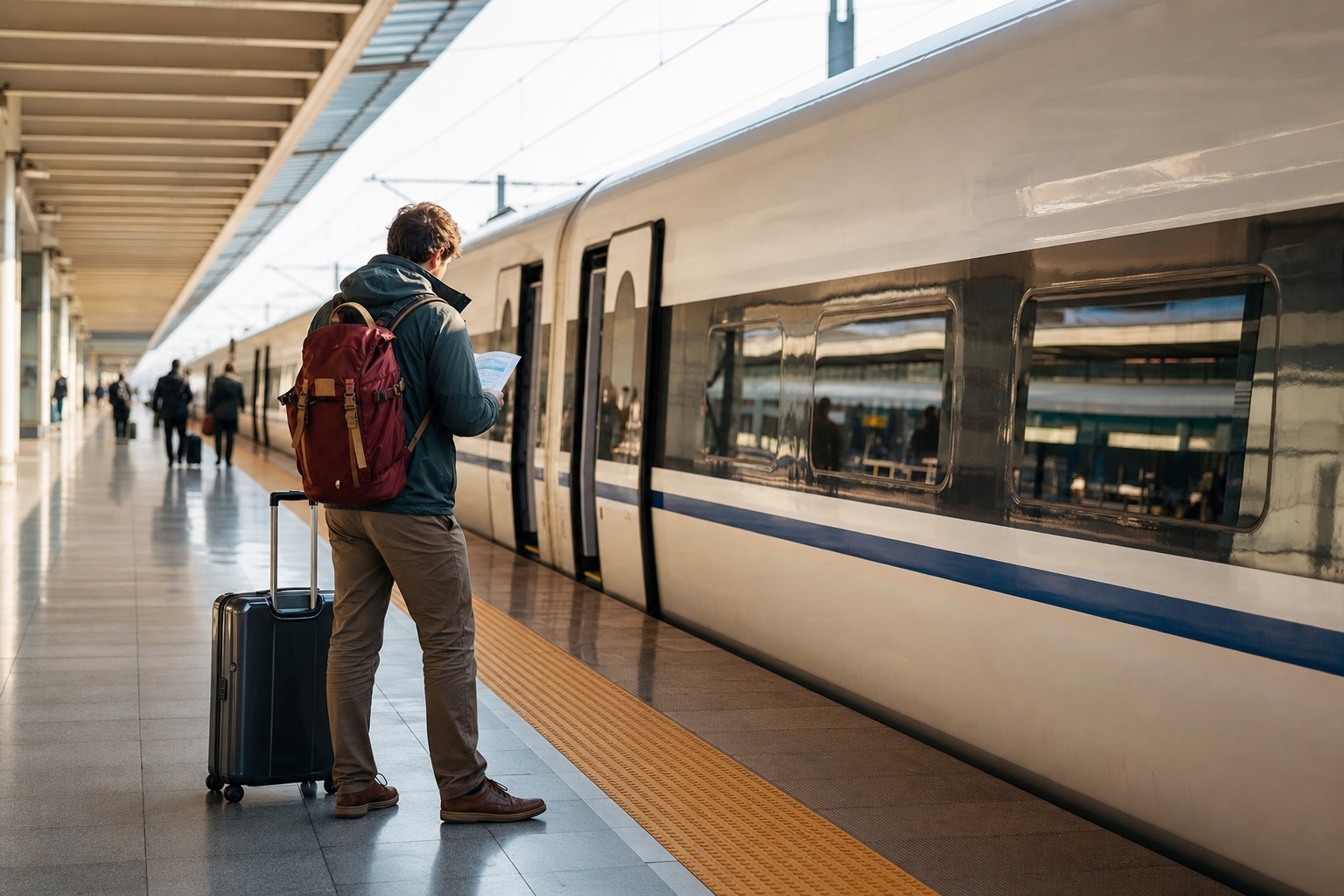
A fast train still creates a door-to-door transfer day.
## Four route templates
### Seven days: one clear contrast
Use **Beijing + Shanghai** for imperial history and contemporary city life. Take a morning high-speed train on day four, then keep the arrival afternoon flexible. If you dislike moving hotels, remain in one base: Beijing with the Great Wall, or Shanghai with Suzhou as a day trip.
| Day | Base | A realistic plan |
|---:|---|---|
| 1 | Beijing | Arrive, activate data and payment, eat near the hotel |
| 2 | Beijing | Forbidden City area plus Jingshan or nearby hutongs |
| 3 | Beijing | Great Wall day; no fixed evening booking |
| 4 | Beijing → Shanghai | Morning train, hotel check-in, riverside walk if energy remains |
| 5 | Shanghai | Bund and former French Concession neighborhoods |
| 6 | Shanghai | Shanghai Museum area, Pudong viewpoint or a chosen theme-park day |
| 7 | Shanghai | Flexible morning and departure |
If the international flights use the same city, remove one sightseeing block for the return journey. Do not hide that backtracking inside “day 7.”
### Ten days: the classic triangle
Spend four nights in Beijing, two in Xi'an and four in Shanghai. The Xi'an stop is short, so stay near a useful metro line or the city wall rather than far outside the center. Do not put the Terracotta Warriors and a same-evening departure on the same day.
The clean sequence is Beijing days 1–4, Xi'an days 5–6 and Shanghai days 7–10. Use the first Xi'an afternoon for the city wall or Muslim Quarter area and the second day for the Terracotta Warriors. If your train reaches Xi'an late, add a night or skip the city; a rushed “two-night stop” can otherwise produce only one usable day.
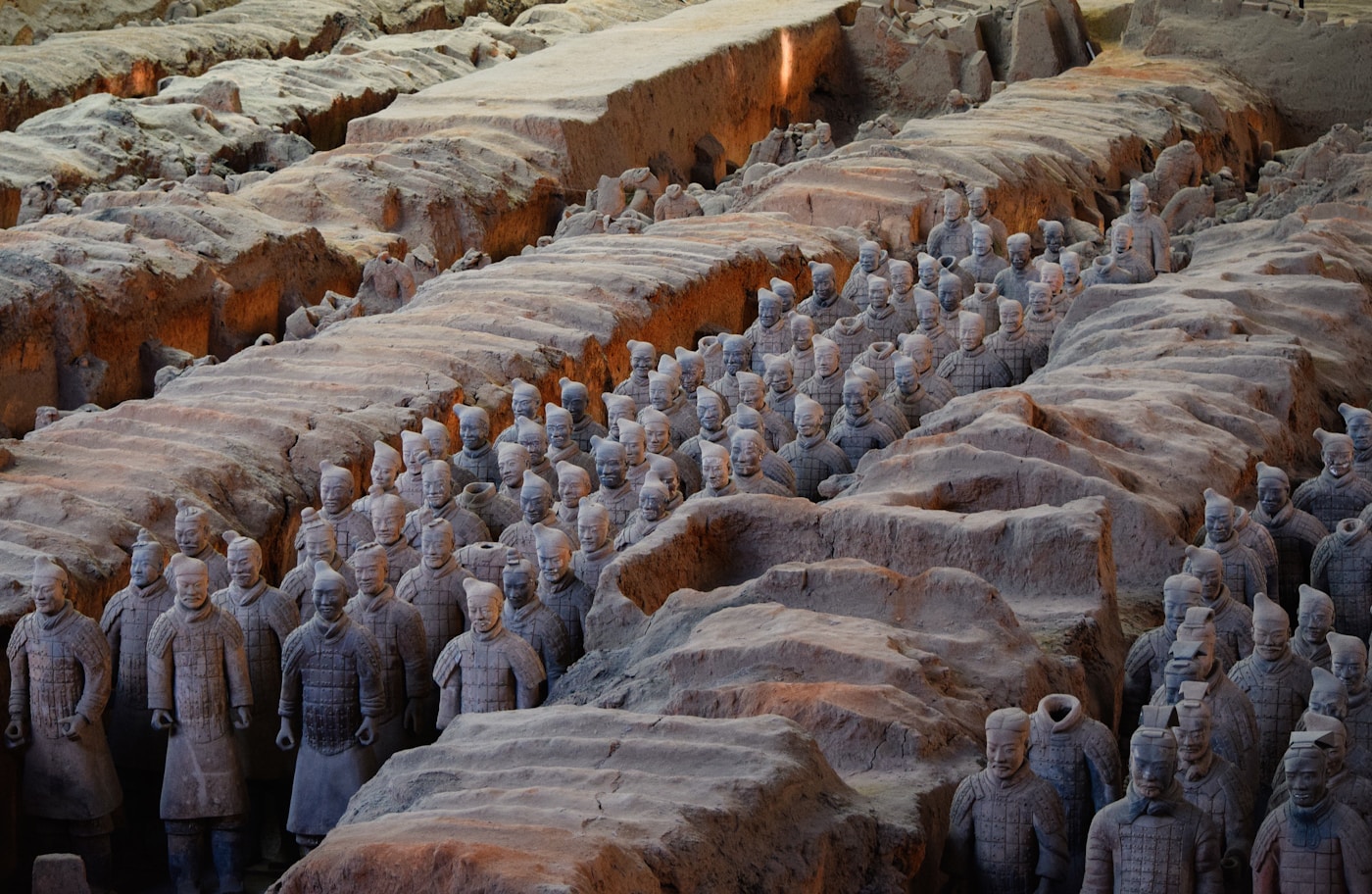
The Terracotta Warriors need their own outing, not a departure-day squeeze.
### Fourteen days: add one personality
Start with the classic triangle, then choose **one** of these:
- **Chengdu:** food, teahouses, pandas and a more relaxed urban rhythm.
- **Zhangjiajie:** landscape, cableways and weather-sensitive mountain days.
- **Suzhou or Hangzhou:** gardens, canals and an easy rail connection from Shanghai.
- **Chongqing:** dense night views, steep streets and a strong city contrast.
Zhangjiajie requires more buffer than an extra city. Use our [Zhangjiajie guide and orientation map](/en/zhangjiajie/) before inserting it into a short route.
Choose the fourth base by the trip you want, not by which name appears most often online:
| If you want… | Add… | Remove or shorten… |
|---|---|---|
| Food and an easier urban rhythm | Chengdu | One Shanghai day if flying home elsewhere |
| Mountain scenery | Zhangjiajie | At least one other city; protect two forest days |
| A gentle finish near Shanghai | Suzhou or Hangzhou | An extra domestic flight |
| Dense night views and steep streets | Chongqing | A second short heritage stop |
Trying to keep Beijing, Xi'an, Shanghai, Chengdu **and** Zhangjiajie in 14 days creates five bases and several fragile transfers. It is possible on paper and usually disappointing in practice.
### Twenty-one days: one corridor plus one region
A balanced first trip can run Beijing → Xi'an → Chengdu → Yunnan → Shanghai. In Yunnan, choose two or three bases rather than collecting Kunming, Dali, Lijiang and Shangri-La at speed. Use the [Kunming–Dali–Lijiang train guide](/en/transport/kunming-dali-lijiang-train/) to check how the regional moves affect your nights.
At 21 days, add depth before distance. A two-night pause in Dali, a free Chengdu afternoon or a second weather window in Zhangjiajie is usually more valuable than another airport. If Tibet, Xinjiang or a far-western route is the main reason for the trip, build a separate regional itinerary instead of attaching it to the classic east-coast circuit.
## The transfer-day test
Before keeping a city, write the day like this:
> checkout → station transfer → security buffer → train or flight → arrival transfer → check-in
If that chain leaves less than four dependable hours, do not assign a must-see attraction to the day. A two-hour train can still create a six-hour door-to-door move. Airports and high-speed rail stations may be far from the neighborhood shown on your hotel map.
Use this quick calculation before buying a ticket:
| Transfer component | Planning allowance |
|---|---:|
| Hotel checkout and final packing | 30–60 minutes |
| Hotel to station | Live map estimate + traffic margin |
| Security and boarding buffer | 45–75 minutes at an unfamiliar major station |
| Train or flight | Published duration |
| Arrival platform to transport | 20–45 minutes in a large hub |
| Arrival station to hotel | Live map estimate + check-in time |
This is not a universal timetable. It is a test for whether the “free afternoon” in your spreadsheet actually exists.
## Build each city around one anchor per day
An anchor is the reservation or place you would regret missing. Put only one fragile item on each day, then surround it with flexible streets, parks or meals.
| Day structure | Example |
|---|---|
| Early flexible stop | Neighborhood walk or public park |
| Timed anchor | Palace museum, theme park or major show |
| Nearby meal | Two saved options outside the main exit |
| Flexible finish | River walk, market or hotel rest |
This matters in China because ticket identity rules, security checks, weather closures and large distances can make back-to-back reservations brittle. See [what to book in advance](/en/what-to-book-in-advance-in-china/) before paying for every day.
## Put the right sight on the right day
Place the most identity-sensitive reservation early enough that a small delay does not collide with the next transfer. Place weather-sensitive mountain days in a two-day window whenever possible. Keep the final day in a city close to the hotel or departure station.
- **Beijing:** do not pair a Great Wall return with a fixed long-distance train.
- **Xi'an:** keep the Terracotta Warriors away from the departure evening.
- **Shanghai:** use neighborhoods and river walks as flexible arrival-day material.
- **Chengdu:** visit the panda base early; keep the afternoon adjustable.
- **Zhangjiajie:** use the clearer forecast for pillar viewpoints and keep a valley route as the swap.
Shanghai works well at the end of a route because several city days can stay flexible.
## Book in this order
1. **International entry and exit points.** Prefer an open-jaw route when the fare is reasonable.
2. **Domestic segments that determine the sequence.** Confirm the actual station and live inventory.
3. **Cancellable hotels.** Save the Chinese name, address and nearest metro exit offline.
4. **Identity-linked attractions.** Enter names exactly as printed in each passport.
5. **Optional experiences.** Add them only after the route has recovery time.
If you travel during National Day, Lunar New Year or a major local holiday, reduce the number of moves again. Our [Golden Week guide](/en/china-golden-week/) explains the special booking order for October 1–7.
## Route adjustments that save a trip
### With children
Replace one long museum or mountain sequence with a free afternoon every three days. Keep a single room for longer and use a high-value day trip. See the full [China with kids guide](/en/china-with-kids/).
### Solo
Avoid late-night arrivals at unfamiliar secondary stations. Choose central, registered accommodation and keep the first evening simple. The [solo female travel guide](/en/solo-female-travel-china/) covers transport, hotel and phone backups.
### With older travelers
Check stairs, cableway queues and the distance between scenic-area gates. A scenic map may show geographic proximity without showing elevation. Build seated breaks into mountain and old-town days.
### During hot, rainy or typhoon-prone periods
Do not make the most weather-sensitive place your only reason for a one-night stop. Give mountain areas a second morning and keep a city or indoor backup.
## Repair the route when one segment fails
Before payment, choose one acceptable fallback for every essential intercity move. The fallback may be a later departure, another station, an extra night or removing a low-priority stop. Write it down while the route is still cheap to change.
If a train is unavailable, do not immediately replace it with a flight. First compare the full door-to-door time and the hotel changes it forces. If a headline attraction is unavailable, keep the city only when it has a second reason to visit. If bad weather removes the only reason for a one-night mountain stop, the route was too fragile from the start.
## Common itinerary failures
- **One night in every city:** most of the trip becomes packing and station access.
- **A flight after a remote day trip:** weather, traffic or scenic shuttles can break the connection.
- **Buying every attraction before transport:** a changed train can strand timed tickets.
- **Using city names instead of station names:** the wrong station can be across the city.
- **No arrival-day plan:** phone setup, payment and hotel check-in need their own margin.
- **No empty block:** one disruption then pushes every later reservation.
## Final check before you pay
For every base, confirm: arrival station, Chinese hotel address, transport to the first sight, one flexible meal option, and the departure buffer. Then remove the city with the weakest reason to stay. That edit usually improves the trip more than adding another attraction.
### Sources and verification
Transport identity and child-ticket rules were checked against the official China Railway 12306 English FAQ. Attraction rules should be rechecked on their official channels because release windows and closures can change. The route limits above are planning recommendations derived from recurring traveler questions, not government rules.