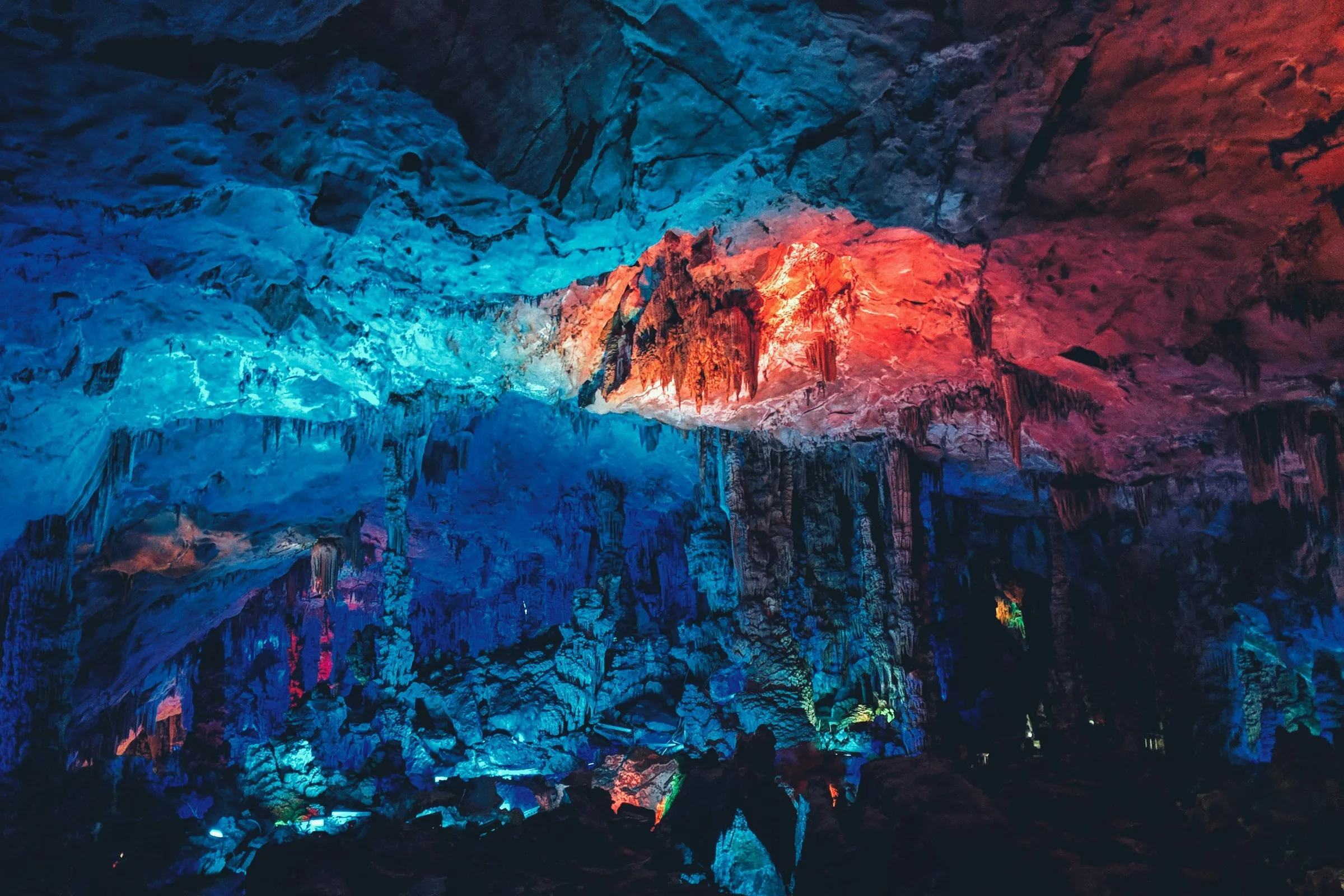
Reed Flute Cave receives two kinds of disappointed visitor. One expected a wild cave and found a managed show cave with strong colored light. The other expected an effortless entrance and was steered toward optional transport or add-ons before understanding the walking route.
The cave itself is straightforward: a large limestone chamber system on the north-west side of Guilin, developed with a fixed visitor path and dramatic lighting. I would use it as a half-day tool, especially when the weather makes an outdoor hill or river walk less attractive.
Set the expectation correctly. This is a managed show cave: real limestone formations interpreted through paths, narration and colored light.
## What the visit actually feels like
You enter with a visitor flow rather than exploring independently. The path moves through chambers of stalactites, stalagmites, columns, curtains and reflective water. Lighting assigns shapes and names to formations; some people find that playful and photogenic, while others feel it distracts from the geology.
Neither reaction is wrong. The useful question is whether you enjoy a **show cave**. If yes, Reed Flute is convenient and visually dense. If you want darkness, silence and natural headlamp exploration, this is the wrong product.
## How long does Reed Flute Cave take?
Plan roughly **40–60 minutes inside** and about **90 minutes at the attraction** after ticketing, waiting, walking from the drop-off and regrouping. Add travel from your hotel.
| Part of the visit | Realistic time |
|---|---|
| Arrival, ticket check and entrance approach | 15–30 min |
| Main cave route | 40–60 min |
| Photographs, exit and pickup | 15–30 min |
Crowds can lengthen photo stops without changing the route. If you need a specific train or flight later, do not treat the advertised cave duration as the full excursion.
## Walking, stairs and temperature
The cave is cooler than a humid Guilin street and can feel damp underfoot. Wear shoes with grip and bring a light layer if you dislike cool interiors. The route includes uneven surfaces and changes of level. Details of lifts or assisted access can change, so contact the attraction before travel if someone in your group cannot manage steps.
For children, the lights and named formations often hold attention better than a geology lecture. Keep hands off formations and do not let a dark path become a running route. For photographers, stabilize yourself rather than blocking the moving group; flash rarely improves a lit cave scene.
## Getting there without buying the wrong “last mile”
Save the Chinese destination **芦笛岩** and confirm that the driver is taking you to the main visitor entrance. The cave is within Guilin's urban area, but the final approach can include signs or sales for optional transport and related attractions.
Before paying for any small train, raft, lift or bundle, I ask one question: “Can I walk from here to the cave entrance, and how many minutes?” A convenience ride may be worthwhile for limited mobility or bad weather. It is not automatically part of the cave ticket.
Public bus routes and operating times change, so check your map app on the day. A taxi or app ride is often the cleanest choice for a small group. Arrange the return pickup at a clearly named gate rather than accepting the first unsolicited offer.
## Tickets and add-ons
Ticket prices, package names and online discounts change. Use the current official or authorized sales channel and check what the product includes. At the counter, separate these questions:
1. Does this ticket include the main Reed Flute Cave route?
2. Is there a timed entry or group departure?
3. Is an optional ride or nearby attraction bundled?
4. Can I walk instead?
5. Are there age, height or passport discount rules?
I would pay for the main cave first. Add another experience only when it solves a mobility problem or sounds enjoyable on its own.
## Reed Flute Cave or Silver Cave?
**Reed Flute Cave** is the convenient city choice. It fits a Guilin hotel day, bad weather, an arrival afternoon or a family schedule.
**Silver Cave (Yinzi Cave)** is generally paired with the Yangshuo area and consumes more transport time from central Guilin. Choose it when you are already building a Yangshuo road day and want the cave to be a main attraction.
I would not visit multiple large show caves on a short Guilin trip. Their formations differ, but the managed-path and colored-light experience overlaps. Save the second slot for the karst landscape outside the cave.
## How to combine it with Guilin city
Three useful pairings:
- **Rainy morning:** Reed Flute Cave → long lunch → Two Rivers and Four Lakes after weather improves.
- **Hot afternoon:** shaded or indoor morning → cave during the hottest hours → lakeside evening.
- **Arrival half-day:** hotel check-in → cave → central Guilin dinner.
I would not schedule Reed Flute before an early Li River cruise departure or on the same tight day as distant Yangshuo attractions. Use the [Guilin and Yangshuo guide](/en/guilin/) to decide which base gets each day.
## Is it worth the price?
Value depends less on the number of formations than on your comparison set.
| Traveler | My call |
|---|---|
| First large cave, family, poor weather | Good use of half a day |
| Photography-first visitor who likes colored light | Worth considering |
| Geology traveler wanting natural presentation | Research carefully; likely too theatrical |
| Already visiting another Guilin/Yangshuo show cave | Usually choose one |
| Only one full day in Guilin region | Prioritize river and open-air karst scenery |
| Limited mobility | Confirm current step-free route before buying |
## Common questions
### Is the cave naturally colorful?
No. The limestone is illuminated with artificial colored lighting. The formations are natural; the palette is part of the visitor presentation.
### Is it good on a rainy day?
Yes. It is one of the more weather-resistant Guilin attractions, though the outdoor approach and transport still matter during heavy rain.
### Do I need a tour?
You do not need a private city tour merely to reach the cave. The attraction uses a managed visitor route. A guide adds value if geology and local interpretation matter to you, not because independent transport is impossible.
## Sources and current checks
- [Guilin Municipal Government](https://www.guilin.gov.cn/)
- [Guilin culture and tourism information portal](https://wglj.guilin.gov.cn/)