<aside class="answer-box">
<p><strong>The short answer</strong></p>
<ul>
<li><strong>Set up Alipay first</strong> if you are visiting China for a short trip. Its English interface, transport tools, ride-hailing and tourist services make it the easier primary wallet for many first-time visitors.</li>
<li><strong>Add WeChat Pay as a second payment rail</strong> if the account and card verification work. It helps when a merchant prefers WeChat, and WeChat itself is useful for contacts, restaurant queues and mini programs.</li>
<li><strong>Do not put the same point of failure in both wallets.</strong> When possible, link cards from different issuing banks and keep some RMB cash.</li>
<li><strong>The published foreign-card fee rule is broadly the same:</strong> payments of RMB 200 or less normally have no extra service fee; above RMB 200, expect 3%. Check the payment screen because product terms and promotions can change.</li>
</ul>
</aside>

If you only have time to make one app work before the flight, choose Alipay. If you can prepare both, do it. The useful comparison is not “which Chinese super-app wins?” It is which setup gives a visitor the fewest ways to get stranded at a counter.

<div class="wallet-decision" role="list" aria-label="Which mobile payment setup should a tourist choose">
  <section role="listitem"><span>ONE APP</span><h2>Choose Alipay</h2><p>Best for a short independent trip when you want one English-friendly place for payments, transport and travel services.</p></section>
  <section role="listitem"><span>BEST COVERAGE</span><h2>Set up both</h2><p>Use Alipay as primary and WeChat Pay as backup. A rejected card or unsupported merchant flow does not then end the transaction.</p></section>
  <section role="listitem"><span>NON-NEGOTIABLE</span><h2>Keep an offline fallback</h2><p>Bring a physical card from a second bank and small RMB notes. Two apps linked to one blocked card are still one payment method.</p></section>
</div>

## The comparison that matters on a real trip

Both wallets can handle ordinary merchant payments in mainland China with eligible overseas cards. Both can fail. The difference shows up in what surrounds the payment.

| Question | Alipay | WeChat Pay |
|---|---|---|
| Best role for a first-time visitor | Primary travel wallet | Second wallet plus messaging layer |
| Overseas phone number | Supported | Supported |
| Passport / identity checks | May be required as the account is used | May be required; extra security review can appear |
| International cards | Major overseas card networks are supported, subject to issuer and product rules | Major overseas card networks are supported, subject to issuer and product rules |
| Tourist utilities | Strong: transport, DiDi, translation and travel mini apps | Useful, but the interface is built around chat and mini programs |
| Social contacts | Not the reason to install it | Strong: locals, guides and businesses commonly use WeChat |
| Foreign-card transfers and red packets | Do not rely on them | Do not rely on them |
| Which merchants accept it | Very broad | Very broad |
| Guaranteed to work everywhere | No | No |

The official 2025 guide for international visitors says foreigners can register mobile-payment apps with a foreign or Chinese phone number and bind cards from major networks. It also warns that card brands, charging standards and limits can vary by product; the screen in front of you is the final rule. See the [Chinese government’s guide to working and living in China](https://english.www.gov.cn/2025special/bizexpatsinchina2025).

## Why Alipay is usually the better first install

Alipay feels closer to a visitor control panel. The home screen is busy, but the useful pieces are recognizable: Pay, Scan, Transport, DiDi, translation and travel services. The app supports multiple languages, and China has explicitly promoted its travel functions for overseas visitors.

That makes Alipay the simpler answer for someone who wants to:

- Pay at a convenience store five minutes after landing.
- Open a city transport code.
- Call a DiDi without creating another payment setup.
- Use in-app translation around a Chinese mini program.
- Keep tickets, rides and everyday payments in one place.

It is still worth reading our separate [Alipay setup and card-decline guide](/en/pay/alipay-for-foreigners/). This comparison page tells you which wallet to try; that guide deals with passport verification, personal QR codes and a card that appears linked but refuses to pay.

## Why WeChat Pay is worth the second setup

WeChat Pay sits inside an app you may need anyway. Hotels, guides, restaurant hosts and people you meet are more likely to exchange a WeChat contact than an email address. Restaurant ordering, attraction notices, queue systems and customer service often live in WeChat mini programs.

This does not mean WeChat Pay is universally better at small vendors. It means it gives you another route when:

- A merchant shows a WeChat code first.
- Your card works in WeChat Pay but not in the Alipay checkout you opened.
- A booking or restaurant flow already lives inside WeChat.
- A local contact sends the correct merchant or mini-program page in chat.

Community reports often say that WeChat asked for an extra verification step, sometimes involving more identity proof. Treat that as a possible security review, not a fixed rule that every foreign user needs a Chinese friend. If WeChat activates cleanly, keep it. If registration becomes a time sink the night before departure, finish Alipay and preserve a physical backup instead.

## The setup order that creates real redundancy

<ol class="wallet-stack">
  <li><span>01</span><div><strong>Install both apps from your normal app store.</strong><p>Do this before departure while SMS, your password manager and your bank app are easy to reach.</p></div></li>
  <li><span>02</span><div><strong>Complete Alipay first.</strong><p>Register with a phone number that can receive verification messages, add an eligible overseas card and follow the identity prompts.</p></div></li>
  <li><span>03</span><div><strong>Add WeChat Pay without making it the critical path.</strong><p>In WeChat, look under Me → Services → Wallet → Bank Cards. The exact menu can vary by account and app version.</p></div></li>
  <li><span>04</span><div><strong>Split the issuing-bank risk.</strong><p>If you have two cards, put Bank A in Alipay and Bank B in WeChat Pay. You can add more than one card where supported.</p></div></li>
  <li><span>05</span><div><strong>Keep your home SIM reachable.</strong><p>Your bank may want an app approval or SMS. A travel eSIM supplies data, but it does not automatically replace the number your bank knows.</p></div></li>
  <li><span>06</span><div><strong>Test a small merchant payment after landing.</strong><p>Buy water or coffee while you still have airport or hotel staff nearby. A card listed in a wallet is not yet a tested payment method.</p></div></li>
</ol>

### Can the same card be linked to both apps?

Often, yes. But that setup protects you mainly from an app-specific failure. If the issuing bank blocks the transaction, both wallets may fail because both eventually charge the same card.

For a stronger setup:

- Alipay: Visa or Mastercard from Bank A.
- WeChat Pay: another eligible card from Bank B.
- Wallet or bag: one physical card and RMB 100–300 in mixed small notes.
- Phone: reliable data plus access to both banking apps.

You do not need to carry a large stack of cash. You need enough to finish a taxi ride, buy food and get back to the hotel when a QR payment is awkward.

## Fees: there is usually no reason to choose by logo

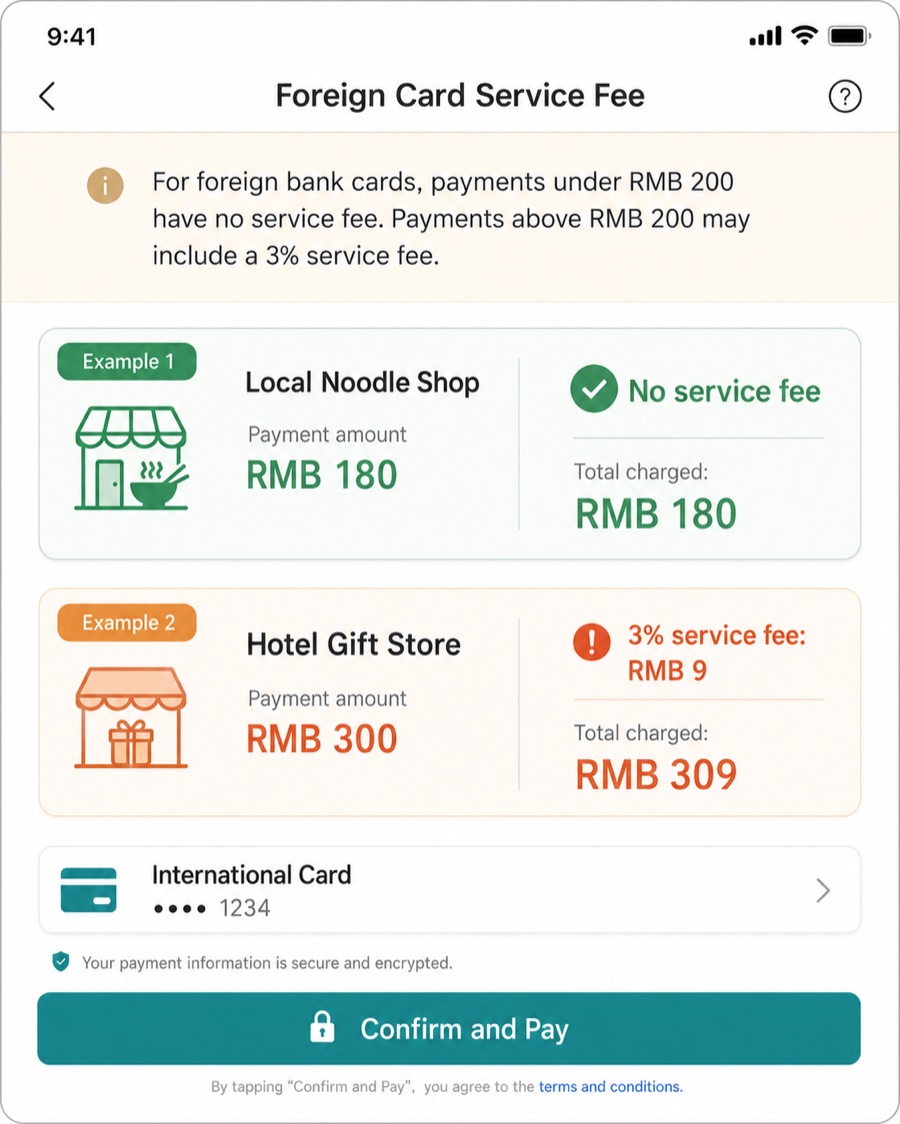
The published rule for overseas cards linked to Alipay or WeChat Pay is:

| Single transaction | Typical platform service fee |
|---|---|
| RMB 200 or less | No additional service fee |
| More than RMB 200 | 3% of the transaction amount |

<figure class="wallet-figure wallet-figure--wide">
  <img src="/images/payments/alipay-foreign-card-fee-examples.jpg" alt="Illustrated foreign-card payment screen comparing a 180 yuan payment with no service fee and a 300 yuan payment with a 9 yuan fee" width="900" height="1124" loading="lazy" />
  <figcaption><strong>Fee line</strong> RMB 200 is the number to remember. A RMB 300 payment may become RMB 309 before any fee charged by your own bank.</figcaption>
</figure>

The [official guide for foreign businesspeople in China](https://nsd.mofcom.gov.cn/tzyts/art/2024/art_a08888d0b9da42f083b00223edaf1de7.html) applies that rule to both Alipay and WeChat. The same guide gives an annual limit of US$50,000 and a single-transaction limit of US$5,000 for international cards. Those ceilings are high enough for normal tourism, but a wallet, card issuer or merchant can impose a lower limit.

Two details are easy to miss:

1. A card with no foreign-transaction fee can still face the wallet’s 3% service fee.
2. The exchange rate is influenced by the card network and issuing bank. One traveler’s screenshot does not prove that Alipay or WeChat always has the better rate.

WeChat and Alipay sometimes run fee-waiver campaigns. Do not build the article—or your budget—around a temporary promotion. Read the amount shown before confirming a larger payment.

## Choose by scene, then switch quickly if it fails

<div class="wallet-scenes" role="list">
  <section role="listitem"><span>CONVENIENCE STORE</span><h3>Alipay first</h3><p>Open your payment code and let the cashier scan it. WeChat Pay and cash are immediate backups.</p></section>
  <section role="listitem"><span>STREET STALL</span><h3>Use the merchant’s supported rail</h3><p>Try the displayed wallet, but keep small cash ready if the code is personal or foreign cards are not enabled.</p></section>
  <section role="listitem"><span>DIDI / TAXI</span><h3>Alipay is convenient</h3><p>Booking and payment can stay inside one app. For a street taxi, agree on the payment method before the ride ends.</p></section>
  <section role="listitem"><span>RESTAURANT MINI PROGRAM</span><h3>WeChat may fit the flow</h3><p>Ordering and queues often live in WeChat. If the mini-program checkout rejects the card, ask for the cashier’s normal merchant code.</p></section>
  <section role="listitem"><span>METRO</span><h3>Use the city-specific transport route</h3><p>Alipay often exposes it clearly. A ticket machine or staffed counter is safer than debugging a transport code before a train.</p></section>
  <section role="listitem"><span>HOTEL / LARGE PURCHASE</span><h3>Compare with a physical card</h3><p>Ask whether the desk accepts your card network directly. The 3% wallet fee can matter on a large bill.</p></section>
</div>

## The QR code is often the real difference

At the counter, “pay by QR” can describe several different transactions:

- You show a payment code and the cashier scans it.
- You scan a registered merchant code and enter the amount.
- You scan a personal collection code that behaves more like a transfer.
- A mini program creates an in-app order with its own card-acceptance rules.

Foreign cards are designed mainly for consumption at supported merchants. They do not turn either account into a full local wallet. Red packets, person-to-person transfers, balance top-ups and some personal collection codes may be unavailable.

When a sticker code fails, ask: “Business QR code?” or show this Chinese sentence:

> 可以用商家收款码或者扫码枪吗？  
> *Kěyǐ yòng shāngjiā shōukuǎn mǎ huòzhě sǎomǎ qiāng ma?*  
> Can I use the merchant QR code or cashier scanner?

Trying the other wallet can work because the merchant enabled one route but not the other. It cannot fix a transaction that is fundamentally a transfer rather than a supported merchant payment.

## If one wallet fails and the other works, that is normal
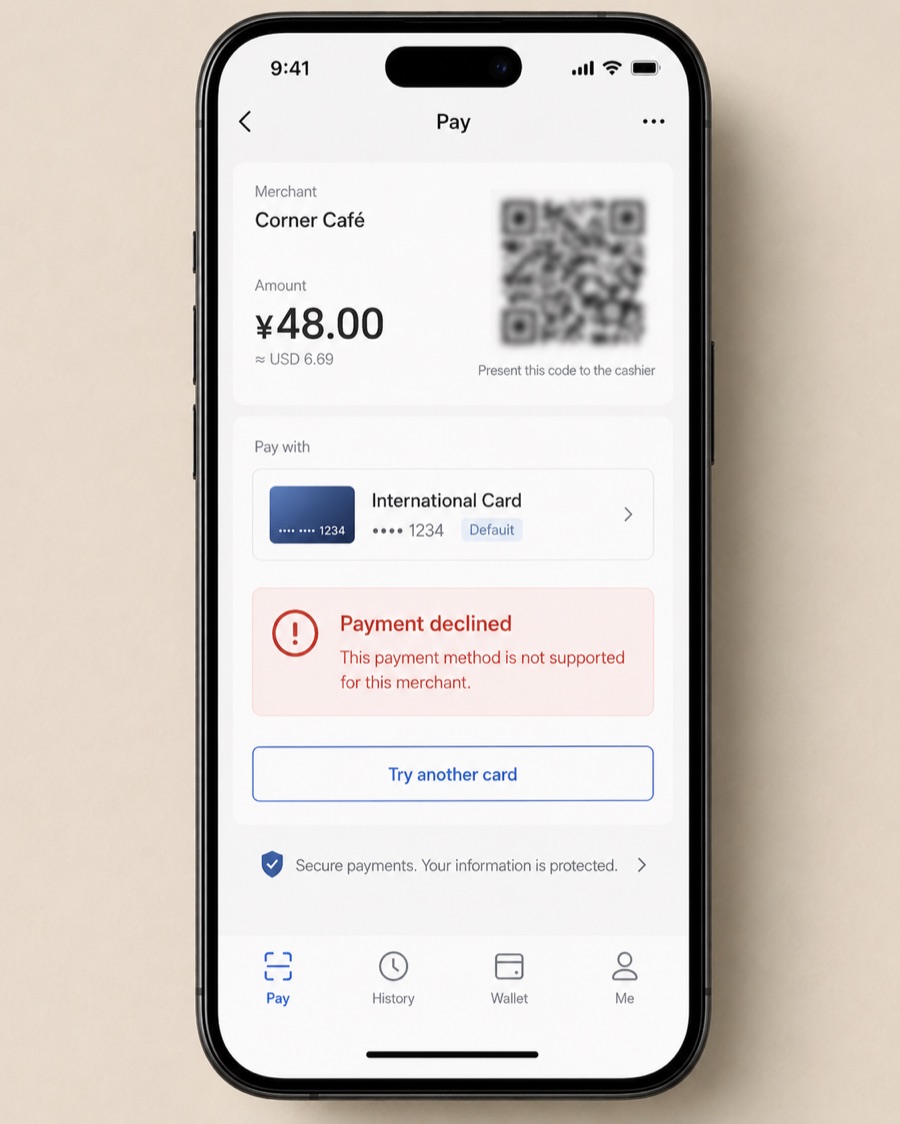
<figure class="wallet-figure wallet-figure--right">
  <img src="/images/payments/alipay-foreign-card-declined.jpg" alt="A generic mobile payment screen showing that an international card was declined because the merchant did not support that payment method" width="900" height="1124" loading="lazy" />
  <figcaption><strong>Linked is not tested</strong> A wallet can display your card even when that merchant, card issuer or payment flow refuses the transaction.</figcaption>
</figure>

The two wallets are separate payment products with separate risk controls, merchant connections and account histories. Your bank may also see them as different merchants. A card can therefore:

- Bind successfully in both apps but pay in only one.
- Work at one shop and fail in a mini program.
- Work for several small purchases and stop at a larger amount.
- Fail until you approve a fraud alert in the banking app.

Use this recovery order:

1. Change the QR flow: let the cashier scan your payment code.
2. Change the wallet: Alipay to WeChat Pay, or the reverse.
3. Change the card: use the other issuing bank.
4. Check the banking app for an approval request.
5. Use cash or a physical card and move on.

Three identical retries are not a strategy. They can add risk-control friction without changing the merchant, wallet or bank condition that caused the failure.

## Do you need a Chinese number or a Chinese friend?

You do not need a Chinese phone number for normal visitor registration. Official guidance says a foreign or Chinese number can be used. The number must remain able to receive verification messages.

A Chinese friend is also not an official prerequisite for every foreign account. WeChat may present additional security verification depending on the account. If it asks another user to help verify, follow only the in-app process and do not pay a stranger for “activation.”

What you do need is less dramatic:

- Your own reachable phone number.
- Passport details that match the account.
- A supported overseas card with online and overseas use enabled.
- Mobile data when the wallet or bank asks for another check.
- A second way to pay.

## A first-day payment plan that takes ten minutes

At the airport or near your hotel:

1. Confirm mobile data works away from public Wi-Fi.
2. Open Alipay and buy one item under RMB 20.
3. Check the bank app for the posted amount and any alert.
4. Open WeChat Pay and make a second small merchant payment if it is ready.
5. Keep RMB cash instead of immediately trying every transport and delivery mini program.

After those two payments, you know which app and card combinations are real. Until then, you only know what the setup screen promised.

## The practical verdict

For most short trips, use this order:

1. **Alipay as the primary wallet.**
2. **WeChat Pay as the second wallet and social layer.**
3. **A different issuing bank as the card backup.**
4. **Small RMB notes as the offline fallback.**

Alipay wins the first-install decision. WeChat Pay earns its place by giving you another merchant route and access to the app many Chinese businesses already use. The strongest setup is not loyalty to either wallet. It is removing the single point of failure.

## Common questions

### Can tourists use Alipay and WeChat Pay without a Chinese bank account?

Yes. Eligible overseas bank cards can be linked for supported merchant payments. The card issuer still has to approve the binding and transactions.

### Is Alipay cheaper than WeChat Pay?

The standard published service-fee rule is broadly the same: payments up to RMB 200 are normally free of the extra service fee; payments above RMB 200 normally incur 3%. Promotions and product terms can differ, so check the confirmation screen.

### Should I link the same card to both?

You can try, but two cards from different banks give better redundancy. The same bank can block both wallets.

### Can I transfer money to a person with a foreign card?

Do not rely on it. Foreign-card access is built primarily for merchant consumption, while transfers, red packets, top-ups and personal collection codes may be restricted.

### What should I do if WeChat Pay asks a friend to verify me?

Follow the official in-app security process if you have a trusted contact. It is not a universal setup requirement. Do not buy verification help from strangers.

### Which app should I use for the metro?

Alipay often makes city transport codes easier to find, but availability and activation vary. If the code does not open quickly, use a ticket machine or service counter rather than missing a train.