China went from "visa for almost everyone" to one of the easier big destinations to enter — but the rules come in **two completely separate schemes**, and people constantly mix them up. Pick the wrong one and you can get turned away at check-in. This page sorts out which one applies to you, in plain terms.
## First, the only question that matters: which scheme are you using?
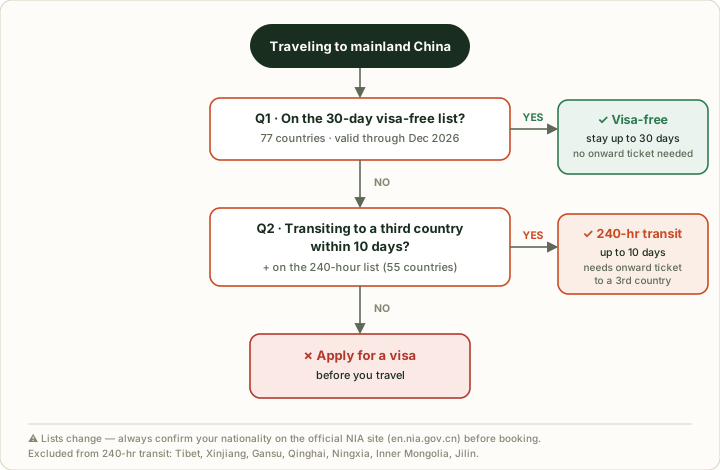
Almost every "do I need a China visa" headache comes from not realizing there are two different doors, with different rules. Figure out your door first:
Two doors into China: the 30-day visa-free list, and the 240-hour transit scheme. Find yours before booking.
## Scheme 1 — 30-day visa-free entry (the simple one)
This is the one most travelers want. If your country is on the list, you enter China **visa-free for up to 30 days** for tourism, business, visiting family, or transit — **no onward third-country ticket required**, and you can move freely through eligible regions.
> "Nationals of these countries holding ordinary passports may enter China visa-free for business, tourism, visits to relatives and friends, exchange visits, or transit, for stays of up to 30 days."
> — [Policy Interpretation, National Immigration Administration](https://en.nia.gov.cn/n147418/n147463/c183390/content.html)
The programme covers **77 countries** and currently runs **through 31 December 2026**. It's been expanding fast — the UK and Canada were added on **17 February 2026**, Sweden back on **10 November 2025**.
## Scheme 2 — 240-hour (10-day) visa-free transit
Different scheme, different rules. The **240-hour visa-free transit** lets eligible travelers stay up to **10 days** while *transiting* China on the way to a **third country or region**. It exists for people who aren't covered by the 30-day scheme, or who only need a short stop.
Key conditions:
- Ordinary passport with **at least 3 months' validity**.
- A confirmed onward ticket (flight, train, or cruise) to a **third country** — not back to where you came from — within 240 hours.
- Entry through one of **around 60 designated ports** across **24 provinces and municipalities**. Your entry port and exit port can be different.
Around **54 nationalities** qualify for the 240-hour transit scheme. Both the country list and the port list get adjusted several times a year, so confirm the current version on the [official NIA site](https://en.nia.gov.cn/) before you book.
## 30-day vs 240-hour transit, side by side
| | 30-day visa-free | 240-hour transit |
|---|---|---|
| Who's eligible | 77 countries | ~54 countries |
| Max stay | 30 days | 10 days (240 hours) |
| Onward ticket to a 3rd country? | **Not required** | **Required** |
| Where you can travel | Most of the mainland | 24 provinces (7 regions excluded) |
| Main purpose | Tourism, business, family, transit | Transit |
| Best for | Most leisure trips | Passing through, or not on the 30-day list |
For most travelers from eligible countries, **Scheme 1 is simpler and gives you more time** — only fall back to the 240-hour transit if your nationality isn't on the 30-day list.
## Is your nationality eligible?
This is the part you must not guess. The lists for both schemes change several times a year as China adds countries.
The current breakdown (2026), grouped by region — this is the **30-day visa-free list**, the scheme most leisure travelers use:
- **Europe:** Andorra, Austria, Belgium, Bulgaria, Croatia, Cyprus, Denmark, Estonia, Finland, France, Germany, Greece, Hungary, Iceland, Ireland, Italy, Latvia, Liechtenstein, Luxembourg, Malta, Monaco, Montenegro, the Netherlands, North Macedonia, Norway, Poland, Portugal, Romania, Russia, Slovakia, Slovenia, Spain, Sweden, Switzerland, and the United Kingdom.
- **Asia & the Middle East:** Japan, South Korea, Saudi Arabia, Oman, Kuwait, Bahrain — plus several others.
- **The Americas:** Canada, Brazil, Argentina, Chile, Peru, Uruguay.
- **Oceania:** Australia and New Zealand.
That covers the bulk of the 77. The separate **240-hour transit** scheme spans a slightly different set of around **54 nationalities** — notably it includes the **United States**, which is *not* on the 30-day list. Both lists are revised several times a year, so even if you see your country above, **confirm the current status on the official source before booking** — one outdated entry is worse than none:
**[National Immigration Administration of China — en.nia.gov.cn](https://en.nia.gov.cn/)**
## How the clock works — you get more time than you think
A detail that quietly gives you an extra partial day: for both schemes, **the stay is counted from 00:00 on the day *after* you enter**, not from the moment you clear immigration.
So if you land at 3pm on the 5th, day one doesn't start until midnight — that afternoon and evening are effectively free. Plan your departure off the official count, not your arrival time.
## The third-country ticket rule (the #1 reason people get refused)
This trips up transit travelers constantly: the 240-hour scheme requires onward travel to a **third** country or region — **not a return to your country of origin**.
Flying London → Beijing → London does **not** qualify. London → Beijing → Tokyo does. Airlines check this at check-in before you even fly, so a round-trip ticket to the same country can get you denied boarding. (The 30-day scheme has no such requirement.)
## Where you cannot go on visa-free transit
The 240-hour transit scheme covers 24 provinces and municipalities — but several regions are **excluded**:
> Not included: **Tibet, Xinjiang, Gansu, Qinghai, Ningxia, Inner Mongolia, and Jilin**.
If your trip centers on Tibet or Xinjiang, transit visa-free won't cover it — you'll need a visa (and, for Tibet, additional permits). The 30-day visa-free scheme is broader, but always verify region-specific rules.
## What you must be ready to show at the border
Visa-free doesn't mean question-free. In practice, have ready:
- Passport valid for the required period.
- Your **onward/return ticket** (mandatory for 240-hour transit).
- Hotel bookings or an address; sometimes an invitation letter.
In practice, most visa-free arrivals clear immigration with **almost no questions** — you fill in the arrival card, get fingerprinted at the kiosk, and you're through. When officers do ask, it's usually one or two simple things: where you're staying and how long. Transit travelers get checked a little harder — have your **onward third-country ticket** and first-night hotel address ready to show, on paper or on your phone. The two things that actually trip people up: a vague "visiting friends" with no address to give, or an onward ticket that loops back to your home country (which fails the transit rule). Keep your answers concrete and you'll rarely be held up.
## What visa-free does NOT allow
Two hard limits worth stating plainly:
- **No paid work**, including remote work for a foreign employer is a legal grey zone — visa-free entry does not grant work rights.
- **No overstaying.** Overstaying or doing paid activity can mean **fines up to 10,000 yuan** and a possible re-entry ban.
Treat the day count as a hard deadline and leave on time.
## Still need a visa? How to tell
If you're **not** on the 30-day list **and** you're not making a genuine third-country transit, you need a regular visa (usually an L tourist visa) from a Chinese embassy or visa center before you travel. Same if your trip is longer than 30 days, or centers on an excluded region like Tibet.
## Sources
- [National Immigration Administration of China (official) — en.nia.gov.cn](https://en.nia.gov.cn/)
- [Policy Interpretation — National Immigration Administration](https://en.nia.gov.cn/n147418/n147463/c183390/content.html)
- [China Extends 240-hour Visa-Free Transit Policy — NIA](https://en.nia.gov.cn/n147413/c183100/content.html)
- [China Visa-Free Travel — A Complete Guide (China Briefing)](https://www.china-briefing.com/news/china-visa-free-travel-policies-complete-guide/)