EUROPE → CHINA · SUMMER 2026
Why China Is Easier for European Travelers in Summer 2026
Visa-free entry, stronger China–Europe flights and widespread indoor cooling make a summer trip easier. See the heat trade-offs and cooler routes.
- 30-day visa-free access for many passports
- July China-Europe bookings +25%
- Indoor cooling is common; outdoor heat still matters

For a European traveler, the important change is not that China suddenly became a different country. It is that several small reasons to postpone the trip have disappeared at the same time. The visa appointment is gone for many passports, more seats are back in the market, and the first hour after landing can now be planned before departure.
In 2026, the practical question is no longer whether the trip can be organised independently. It can. The harder decision is whether China is the right use of your summer dates once heat, distance and the temptation to add too many cities are included.
What the 2026 numbers actually show
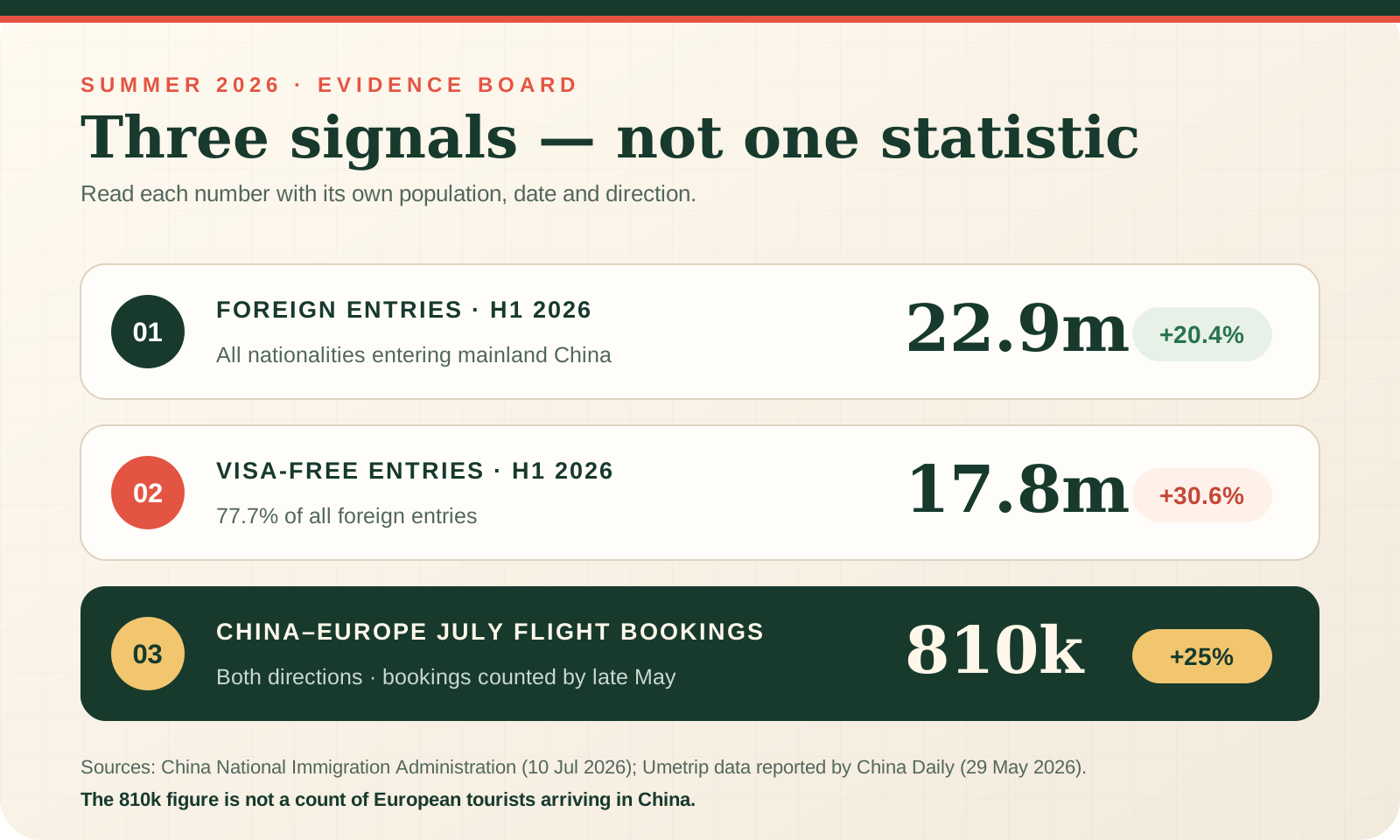
China’s National Immigration Administration recorded 22.914 million foreign entries in the first half of 2026, up 20.4% year on year. Of those, 17.815 million were visa-free entries—77.7% of the total and 30.6% above a year earlier.
The same release also shows where the evidence stops. Its ten largest origin markets included Russia, but no broad set of Western European countries. Overall foreign arrivals are clearly growing; the release does not provide a comparable leisure-visitor total for Europe alone.
The clearest Europe-specific signal is aviation. Umetrip data reported on May 29 showed more than 810,000 bookings for July flights between China and Europe, up 25% year on year, with more than 10,000 planned flights, up about 27%. These are China–Europe bookings in both directions, not 810,000 Europeans entering China.
Taken together, the three figures point to lower friction and stronger demand. I have kept them separate because none of the sources provides a 2026 nationality breakdown for European leisure travelers.
1. The visa stopped being a separate project
For much of Europe, a short China trip now begins with a passport check rather than a visa-center appointment. China says unilateral visa-free entry is available to nationals of 50 countries, while the 240-hour transit scheme covers eligible travelers through 65 entry ports.
The exact rule still depends on the passport. The current UK government guidance says British citizens can enter visa-free for up to 30 days for tourism, business, family or friend visits, or transit through 31 December 2026. Germany’s Foreign Office gives German citizens the same 30-day window under stated conditions through that date. The broader 50-country program covers many other European passports, but the dates and eligible purposes must be checked country by country.
This matters most for a summer decision made late. Removing a visa application does not just save a fee. It removes the uncertainty of finding an appointment, surrendering a passport and guessing whether the document will return before the flight.
Do not assume “European resident” means eligible. The rule follows the passport, not where you live or which airport you fly from. Check our China visa-free guide and then confirm the current wording with the Chinese embassy responsible for your passport.
2. More flight capacity makes a multi-city trip easier to price
Restored routes and higher frequencies do not guarantee a cheap fare, but they give travelers more combinations of departure city, arrival gateway and return city. That is especially useful in China because the most efficient first trip is rarely a perfect circle.
A London–Beijing arrival with a Shanghai–London return can save an unnecessary domestic backtrack. The same logic works from Paris, Frankfurt, Milan, Madrid or another hub when the open-jaw fare is sensible. I would compare the whole route—not just the cheapest inbound flight—before choosing airports.
The July booking data also explains why waiting for a dramatic last-minute bargain is risky. A route can have more seats and still fill them. Compare a return ticket with an open-jaw ticket, then add the train or domestic flight that the cheaper option forces you to buy.

3. The first day is easier to engineer before takeoff
China’s digital ecosystem is still different from Europe’s. Google services, WhatsApp and Instagram do not behave normally on a local connection, overseas bank cards are not accepted at every small merchant, and many reservations are tied to a passport number.
The trip now has a repeatable pre-flight setup:
- Install a roaming China eSIM or confirm an international roaming plan before departure.
- Set up Alipay with an overseas card and keep a second payment method.
- Save the hotel name and address in Chinese.
- Use an English booking route for the first intercity train, then keep the same passport with the booking.
- Download the apps you need before the flight; check our blocked-app guide rather than discovering the difference at baggage claim.
China will still feel different from traveling inside the EU. The useful improvement is predictability: you can know which services need an alternative and finish most of the setup at home.


4. A 9–14 night holiday can follow a straight route
With 9–14 nights, the long flight starts to make sense and the route can move in one direction. High-speed rail does the useful middle work; an open-jaw flight avoids returning to the arrival city solely to fly home.
For a first trip, I would use one of these shapes:
| Time available | Route shape | Why it works |
|---|---|---|
| 7–9 nights | Beijing → Xi’an → Shanghai | Three distinct cities, two logical rail legs, open-jaw flight potential |
| 10–12 nights | Beijing → Xi’an → Shanghai + Hangzhou or Suzhou | Adds one compact side trip without rebuilding the route |
| 12–15 nights | Beijing or Shanghai + Yunnan | Combines a major gateway with a slower, higher-altitude second half |
China is less forgiving than a dense European rail circuit. Beijing to Shanghai is already a major intercity move. Add Chengdu, Guilin and Hong Kong to a ten-day trip and too much of the holiday disappears into transfers and check-ins.

Our China train-ticket guide covers passport verification and the 12306 versus Trip.com choice. For a first route decision, compare Beijing and Shanghai before adding both automatically.
Summer is the reason to travel—and the main reason to hesitate
School holidays and synchronized annual leave make July and August the realistic window for many Europeans. They are not the gentle-weather window for much of eastern China.
Beijing can be intensely hot; Shanghai adds humidity; Xi’an’s monumental outdoor sites expose you to long hours in the sun. Domestic school holidays also increase pressure at famous attractions. The itinerary can still work, but the useful hours shift toward mornings and evenings.
My summer rule would be:
- protect 08:00–11:00 for outdoor sights;
- use the middle of the day for a museum, meal, train or hotel break;
- reserve major attractions before the route is emotionally “finished”;
- avoid adding a city merely to justify the long flight;
- keep one weather-flexible block in every three days.
Indoor cooling is one reason the trip feels easier than expected
In Europe, a hot day often follows you indoors. A 2026 World Weather Attribution report put European household air-conditioning ownership at around 20%. The EU Energy Poverty Advisory Hub says 26% of EU households were unable to keep their homes comfortably cool in summer 2022, rising to nearly 35% among the lowest-income group. Much of Europe’s housing was built for retaining warmth; adding cooling can mean landlord approval, building restrictions, exterior-unit limits or a costly retrofit.
China comes from a different cooling baseline. The International Energy Agency describes it as the world’s largest room-air-conditioner market and notes that commercial buildings have increasingly adopted central HVAC. Split systems also make it possible to add cooling room by room without installing ductwork throughout an older building. For a traveler, that difference is visible in modern city hotels, airports, shopping centres, museums, high-speed trains and many metro systems. China’s National Energy Administration expects the national electricity system to remain broadly balanced in summer 2026, even as air-conditioning pushes peak demand higher.
I would still check the room rather than trust the destination. An old courtyard guesthouse, heritage building, rural stay or small local restaurant may have weak cooling or none at all. On a booking page, look for air conditioning in the room, not just a fan or cooling in public areas. If heat tolerance is low, a modern hotel near the day’s first sight is often worth more than an extra star on the edge of town.
Air conditioning also changes the timetable, not the climate. It makes a midday museum, lunch or hotel break practical; it does not make a two-hour walk across an exposed palace complex comfortable at 14:00.
If dates are flexible, April–May and mid-September–October are usually easier for the Beijing–Xi’an–Shanghai axis. If summer is fixed, consider using a higher-altitude region for part of the trip.
If cool weather is the priority, change the destination
Do not search for a magically cool version of Shanghai or Xi’an in July. Change the geography instead. These are the three summer alternatives I would compare first:
| Route | Why it feels cooler | Trade-off to accept |
|---|---|---|
| Kunming → Dali → Lijiang; add Shangri-La only if altitude suits you | A highland route with milder daytime temperatures than the eastern megacity circuit | May–October is Yunnan’s wetter season; altitude and UV rise as the route moves north |
| Xining → Qinghai Lake / eastern Qinghai | Official climate data puts the region’s summer averages below 24°C; Xining’s 1991–2020 summer average was 15.1°C | Xining sits around 2,000 metres and the wider region goes higher; dry air, UV and long road transfers matter |
| Guiyang → Anshun / western Guizhou | Guiyang’s summer average is about 23.2°C, with typical highs around 25–28°C | The coolness comes with humidity and frequent rain; this is a slower landscape route, not a checklist of famous first-trip landmarks |
For the gentlest first choice, I would start with Yunnan and stop at Lijiang unless everyone handles altitude well. Xining is cooler on the numbers but asks more of the body. Guiyang works for travelers who would rather accept rain than dry heat.
Use our month-by-month China guide before fixing the route. “Summer in China” is too broad a forecast; Beijing, Shanghai, Yunnan, Guizhou and the Qinghai plateau do not share one climate.
Who benefits most from the 2026 change?
The strongest fit is a traveler who:
- holds a passport currently covered by 30-day visa-free entry;
- has 9–14 nights and can use an open-jaw flight;
- is comfortable setting up mobile data and payment before landing;
- wants both historic sites and contemporary city life;
- accepts early starts and midday breaks in hot weather.
I would wait for a shoulder season if the trip is mainly long urban walks, small children do badly in heat, or the itinerary depends on outdoor landmarks every afternoon. I would also slow down before booking if the passport is not visa-free: the trip may still work, but it is a different planning timeline.
Keep the three datasets separate
The figures answer different questions. Mixing them would create a much stronger claim than the sources support.
| Published figure | What it supports | What it cannot tell us |
|---|---|---|
| 22.914 million foreign entries in H1 2026 | Overall international arrivals are growing | How many were European leisure visitors |
| 17.815 million visa-free entries | Visa-free travel is now the dominant entry channel for eligible foreign visitors | Trip purpose or a Europe-only total |
| 810,000 July China–Europe flight bookings | Demand on the air corridor was ahead of 2025 by late May | One-way inbound arrivals or a universal fall in fares |
The current visa waivers also have an end date. Many European passport rules are stated through 31 December 2026, so a later trip needs a fresh check.
My conclusion is narrower than the original trend headline: China is appearing on more European summer shortlists because the trip is easier to start, connect and operate independently. The published evidence does not yet support an exact continent-wide visitor count.
Common questions
Do Europeans need a visa for China in summer 2026?
Many European passport holders can enter mainland China visa-free for up to 30 days for eligible short visits, but the rule is nationality-specific and currently time-limited. Check the exact passport and purpose before booking.
Is July or August a good time for a first China trip?
It is workable when school or work calendars require it, but it is hot and busy on the classic eastern route. Start early, plan indoor midday blocks and consider a cooler or higher-altitude second region.
Is air conditioning common in China?
It is common in modern city hotels, airports, malls, museums and long-distance transport, but it is not universal. Check the individual room when booking an old guesthouse, heritage property or rural stay, and do not use indoor cooling as a reason to schedule exposed outdoor sights in the afternoon.
Are China–Europe flights cheaper in 2026?
More planned flights improve choice, but the published data shows bookings and capacity—not a universal fare drop. Compare open-jaw and return itineraries after adding domestic transport.
Can I travel independently without speaking Chinese?
Yes on a major-city route if data, payment, addresses and key bookings are prepared before arrival. Save Chinese names and keep offline copies; English availability drops quickly outside major transport and hotel settings.
Sources checked
- China National Immigration Administration: first-half 2026 border and foreign-entry data
- China–Europe July flight bookings and planned capacity, citing Umetrip
- China’s 2026–2030 tourism plan and current visa-free program
- UK government: entry requirements for British citizens
- German Foreign Office: China entry and visa-free conditions
- EU Energy Poverty Advisory Hub: residential cooling demand and summer energy poverty
- World Weather Attribution: June 2026 European heatwave report
- International Energy Agency: The Future of Cooling in China
- China National Energy Administration: summer 2026 power-supply outlook
- China Weather: Qinghai summer climate and Xining data
- China Weather: Kunming climate overview
- China Weather: Guiyang climate overview