Visas & entry
China visa and entry hub
Start here for China entry rules in 2026: 30-day visa-free countries, 240-hour transit, regular visa cases, the digital arrival card, and what to prepare before you fly.
China went from “visa for almost everyone” to one of the easier big destinations to enter — but the entry system now has three different doors: 30-day visa-free entry, 240-hour visa-free transit, and regular visas. Pick the wrong door and you can get refused at airline check-in before you even reach China. Use this page as the hub: choose your entry path, then jump to the right passport guide, arrival-card step, and pre-trip setup.
Start here: choose your China entry path
| Your trip | Use this path | Next page |
|---|---|---|
| Your passport is on China’s 30-day visa-free list and the trip is 30 days or less | 30-day visa-free entry | Stay on this page, then check your passport guide below |
| You are not on the 30-day list, but you are flying/railing/sailing through China to a different country or region within 10 days | 240-hour visa-free transit | Run the 240-hour transit checker |
| You are entering for work, study, journalism, long stay, or a non-eligible passport/route | Regular visa | Check the Chinese embassy or visa center before booking |
| You will clear mainland immigration under any of the above | Digital Arrival Card too | Fill the China arrival card |
This matters because the 30-day visa-free scheme and 240-hour transit are not interchangeable. The 30-day scheme is a nationality-based entry permission. The 240-hour scheme is a route-based transit permission. A US passport holder, for example, is not on the 30-day list, but may qualify for 240-hour transit if the route is genuine third-country transit.
Passport-by-passport quick links
Each guide covers exactly which scheme applies, what to bring, and the traps that get people refused:
- United States — visa or 240-hour transit (not on the 30-day list)
- United Kingdom — visa-free, 30 days (since Feb 2026)
- Canada — visa-free, 30 days (since Feb 2026)
- Australia — visa-free, 30 days
- Germany — visa-free, 30 days
- France — visa-free, 30 days
- Spain — visa-free, 30 days
- Italy — visa-free, 30 days
- Japan — visa-free, 30 days (since Nov 2024)
- South Korea — visa-free, 30 days (since Nov 2024)
- India — tourist visa required
First, the only question that matters: which scheme are you using?
Almost every “do I need a China visa” headache comes from not realizing there are two different doors, with different rules. Figure out your door first:
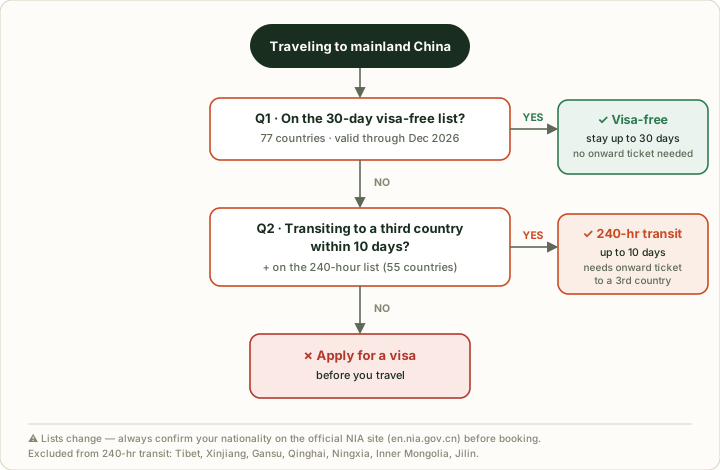
Scheme 1 — 30-day visa-free entry
This is the one most travelers want. If your country is on the list, you enter China visa-free for up to 30 days for tourism, business, visiting family, or transit — no onward third-country ticket required, and you can move freely through eligible regions.
“Nationals of these countries holding ordinary passports may enter China visa-free for business, tourism, visits to relatives and friends, exchange visits, or transit, for stays of up to 30 days.” — Policy Interpretation, National Immigration Administration
The programme covers 50 countries in the current NIA English policy interpretation. It has expanded quickly — the UK and Canada were added on 17 February 2026, and Sweden was added before that — so do not rely on an old travel blog or embassy screenshot. Confirm the current list before booking.
Scheme 2 — 240-hour (10-day) visa-free transit
Different scheme, different rules. The 240-hour visa-free transit lets eligible travelers stay up to 10 days while transiting China on the way to a third country or region. It exists for people who aren’t covered by the 30-day scheme, or who only need a short stop.
Key conditions:
- Ordinary passport with at least 3 months’ validity.
- A confirmed onward ticket (flight, train, or cruise) to a third country — not back to where you came from — within 240 hours.
- Entry through one of 65 designated ports across 24 provinces and municipalities. Your entry port and exit port can be different.
55 nationalities qualify for the 240-hour transit scheme. Both the country list and the port list get adjusted several times a year, so confirm the current version on the official NIA site before you book.
If transit is your route, our 240-hour transit visa-free guide covers the full rules, eligible countries, ports and which cities you can visit — and has a trip checker that runs your actual dates and route against all five tests.
30-day vs 240-hour transit, side by side
| 30-day visa-free | 240-hour transit | |
|---|---|---|
| Who’s eligible | 50 countries | 55 countries |
| Max stay | 30 days | 10 days (240 hours) |
| Onward ticket to a 3rd country? | Not required | Required |
| Where you can travel | Most of the mainland | 24 provinces (7 regions excluded) |
| Main purpose | Tourism, business, family, transit | Transit |
| Best for | Most leisure trips | Passing through, or not on the 30-day list |
For most travelers from eligible countries, Scheme 1 is simpler and gives you more time — only fall back to the 240-hour transit if your nationality isn’t on the 30-day list.
Is your nationality eligible?
This is the part you must not guess. The lists for both schemes change several times a year as China adds countries.
The current breakdown (2026), grouped by region — this is the 30-day visa-free list, the scheme most leisure travelers use:
- Europe: Andorra, Austria, Belgium, Bulgaria, Croatia, Cyprus, Denmark, Estonia, Finland, France, Germany, Greece, Hungary, Iceland, Ireland, Italy, Latvia, Liechtenstein, Luxembourg, Malta, Monaco, Montenegro, the Netherlands, North Macedonia, Norway, Poland, Portugal, Romania, Russia, Slovakia, Slovenia, Spain, Sweden, Switzerland, and the United Kingdom.
- Asia & the Middle East: Japan, South Korea, Saudi Arabia, Oman, Kuwait, Bahrain — plus several others.
- The Americas: Canada, Brazil, Argentina, Chile, Peru, Uruguay.
- Oceania: Australia and New Zealand.
That covers the bulk of the 50. The separate 240-hour transit scheme spans a slightly different set of 55 nationalities — notably it includes the United States, which is not on the 30-day list. Both lists are revised several times a year, so even if you see your country above, confirm the current status on the official source before booking — one outdated entry is worse than none:
National Immigration Administration of China — en.nia.gov.cn
Entry checklist: what to prepare after you choose a path
| Before you fly | 30-day visa-free | 240-hour transit | Regular visa traveler |
|---|---|---|---|
| Passport | Ordinary passport, valid for your trip | Ordinary passport, usually at least 3 months’ validity | Passport valid under embassy/visa-center rules |
| Visa / permission | No visa if nationality and purpose qualify | No visa if nationality, route, port, area and clock qualify | Visa issued before travel |
| Ticket | Return/onward ticket recommended | Confirmed onward ticket to a third country or region required | Follow visa and airline requirements |
| Address | First-night hotel/address ready | First-night hotel/address ready | First-night hotel/address ready |
| Arrival card | File the free Digital Arrival Card | File the free Digital Arrival Card if clearing immigration | File the free Digital Arrival Card |
| On-arrival setup | eSIM + Alipay/WeChat Pay | eSIM + Alipay/WeChat Pay | eSIM + Alipay/WeChat Pay |
The hub logic is: visa status first, arrival card second, practical setup third. Do not wait until the plane lands to solve data, payment, and address details — those are the exact things immigration queues make stressful.
After entry status: the next pages to open
- Arrival card: China Digital Arrival Card — official-vs-scam check, exemption decision tree, scenario table, and QR checklist.
- Transit: 240-hour transit checker — use it if you are not on the 30-day list or your trip is a genuine stopover to a third country.
- Internet: Best eSIM for China — have data working before the border queue.
- Payments: Alipay for foreigners — set up payment before you are standing at a taxi rank or metro gate.
- Apps: Apps blocked in China — know what works before relying on Google, WhatsApp, Instagram, or Gmail.
How the clock works — do not mix the two schemes
The “starts at 00:00 on the following day” rule belongs to the 240-hour transit scheme. If you enter on that scheme at 3 p.m. on the 5th, the 240-hour clock starts at 00:00 on the 6th.
Do not automatically add that partial day to a 30-day visa-free stay. It is a different legal route. Plan conservatively within the permitted stay recorded at entry, and confirm a borderline departure with the Chinese embassy, airline or immigration authority before booking.
Quick questions on counts and domestic connections
How many countries are on the lists right now?
As checked on 25 August 2026, the main 30-day unilateral visa-free policy covers 50 countries in the current NIA English interpretation. The 240-hour transit policy covers 55 nationalities and 65 entry ports in 24 provincial-level areas. These numbers have changed before; recheck the NIA source near departure.
Can I take a domestic flight after entering on 240-hour transit?
It can be part of the trip if both cities and the route remain within the policy’s permitted area. Your final departure still must leave mainland China for the qualifying third country or region from an eligible port within the time limit. A domestic flight is not the required onward third-country ticket.
What if my international ticket connects through another mainland city first?
The place where you first clear mainland immigration is your entry port. It must support the policy, and your subsequent movement must remain inside the permitted area. Do not assume an international label on the whole ticket makes an ineligible first entry point valid.
The third-country ticket rule (the #1 reason people get refused)
This trips up transit travelers constantly: the 240-hour scheme requires onward travel to a third country or region — not a return to your country of origin.
Flying London → Beijing → London does not qualify. London → Beijing → Tokyo does. Airlines check this at check-in before you even fly, so a round-trip ticket to the same country can get you denied boarding. (The 30-day scheme has no such requirement.)
Where you cannot go on visa-free transit
The 240-hour transit scheme covers 24 provinces and municipalities — but several regions are excluded:
Not included: Tibet, Xinjiang, Gansu, Qinghai, Ningxia, Inner Mongolia, and Jilin.
If your trip centers on Tibet or Xinjiang, transit visa-free won’t cover it — you’ll need a visa (and, for Tibet, additional permits). The 30-day visa-free scheme is broader, but always verify region-specific rules.
What you must be ready to show at the border
Visa-free doesn’t mean question-free. In practice, have ready:
- Passport valid for the required period.
- Your onward/return ticket (mandatory for 240-hour transit).
- Hotel bookings or an address; sometimes an invitation letter.
- Your Digital Arrival Card QR — since 20 Nov 2025 nearly every foreign visitor (visa-free and transit included) must file it online before arrival. See how to fill in the China Digital Arrival Card.
In practice, most visa-free arrivals clear immigration with almost no questions — you show your arrival-card QR, get fingerprinted at the kiosk, and you’re through. When officers do ask, it’s usually one or two simple things: where you’re staying and how long. Transit travelers get checked a little harder — have your onward third-country ticket and first-night hotel address ready to show, on paper or on your phone. The two things that actually trip people up: a vague “visiting friends” with no address to give, or an onward ticket that loops back to your home country (which fails the transit rule). Keep your answers concrete and you’ll rarely be held up.
What visa-free does NOT allow
Two hard limits worth stating plainly:
- No paid work, including remote work for a foreign employer is a legal grey zone — visa-free entry does not grant work rights.
- No overstaying. Overstaying or doing paid activity can mean fines up to 10,000 yuan and a possible re-entry ban.
Treat the day count as a hard deadline and leave on time.
Still need a visa? How to tell
If you’re not on the 30-day list and you’re not making a genuine third-country transit, you need a regular visa (usually an L tourist visa) from a Chinese embassy or visa center before you travel. Same if your trip is longer than 30 days, or centers on an excluded region like Tibet.
Sources
Affiliate link — we may earn a commission at no extra cost to you. Booking is completed on Klook.