City guide
Xi'an Travel Guide (2026): Terracotta Army, City Wall & Local Tips
How to do Xi'an right in 2-3 days: the ¥7 public bus to the Terracotta Army, cycling the only intact city wall in China, and the back-alley food the Muslim Quarter main drag hides from you.
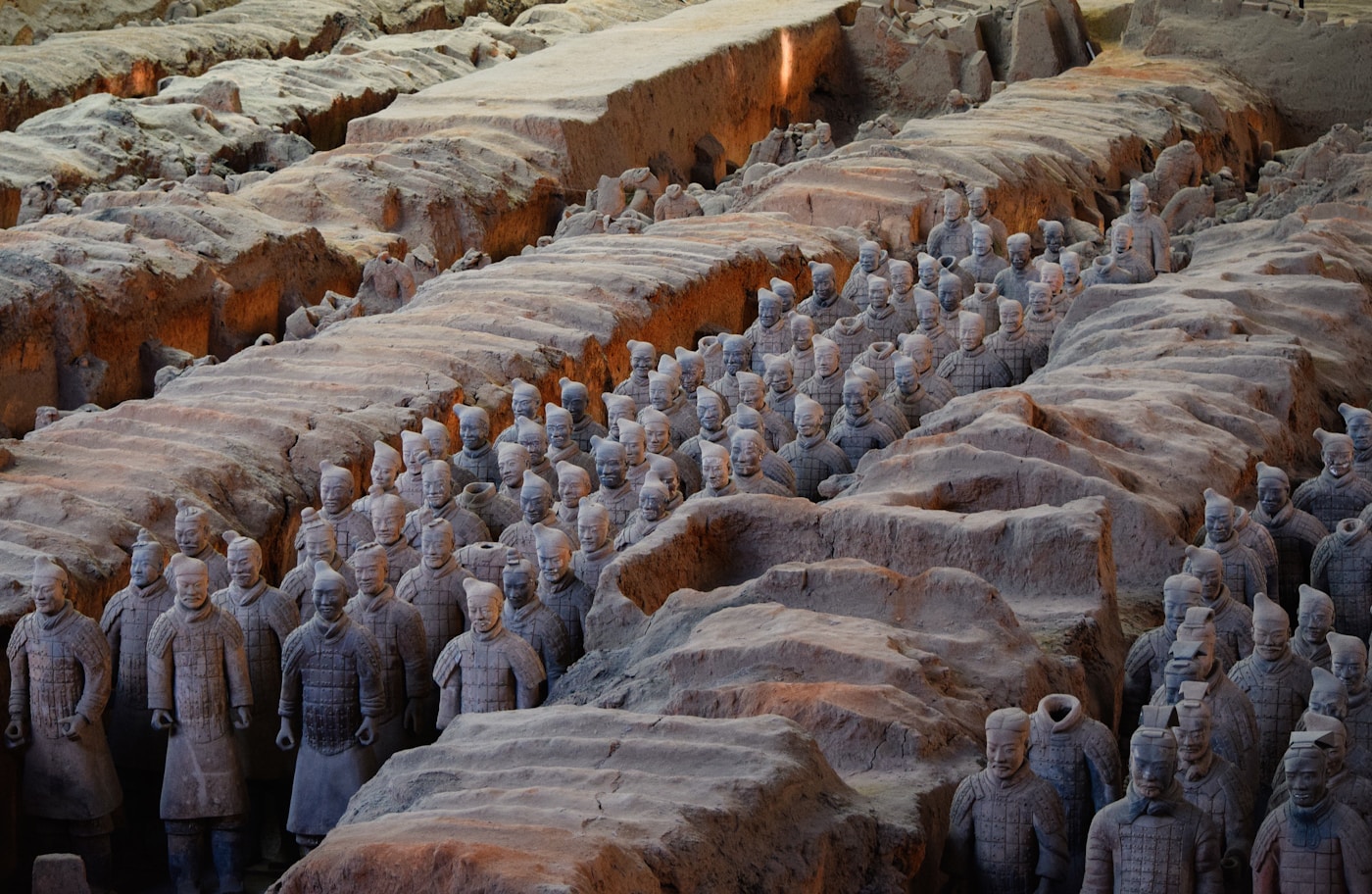
Most people fly into Xi’an for one reason — to stand in front of an army of 2,200-year-old clay soldiers — and leave having also fallen for the city itself: the only fully intact Ming-dynasty wall in China, a Muslim Quarter that smells of cumin and roasting lamb at midnight, and noodles wide enough to slap (the character for “biangbiang” has 58 strokes and isn’t on any keyboard). It’s also the city where foreigners get fleeced hardest if they wing it — fake “tourist buses” to the warriors, a Muslim Quarter main street that doubles every price. Here’s how to do it like someone who’s done it.
How many days do you need?
Two and a half days covers the headline sights without rushing: a half-day for the Terracotta Army (it’s 40km out of town), a full day for the city wall, Muslim Quarter, and Bell/Drum Towers, and a half-day for the Shaanxi History Museum and Big Wild Goose Pagoda. Three days lets you breathe and add a long evening at the Tang dynasty light shows. A fourth day is for Mt. Huashan only if vertiginous granite stairs sound like fun rather than punishment. More than four days and you’re stretching — Xi’an is a compact city, not a week-long base. If your rail route continues north, Pingyao is a better separate overnight stop than another filler day here. If it continues west along the Silk Road, Dunhuang needs its own two- or three-day plan built around the Mogao Caves ticket.
The Terracotta Army: how to actually get there (and not get scammed)
This is the single sight that defines the trip, and it’s also where the scams cluster. Here’s the clean way.
Take public bus 游5 (route 306) from the east plaza of Xi’an Railway Station (火车站东广场). It’s ¥7 each way, runs roughly 8:00–19:00 at short intervals, and takes about an hour. You buy your ticket from the conductor after you sit down — that’s normal. The real bus is government-run, green, marked 306, with a uniformed conductor.
The scam: touts loiter around the station steering tourists onto fake “Tourist Bus 5” coaches that look almost identical, then detour to a jade “factory,” a fake Banpo museum, and a long lunch stop before dumping you at the warriors hours late. If anyone approaches you offering to “show you the bus” or sells you a ticket off the bus, walk away. Find the bus yourself — it’s in the open lot on the east side. If you’d rather not deal with it at all, a DiDi runs around ¥80–120 each way.
Once there, the site is called the Emperor Qinshihuang’s Mausoleum Site Museum. Tickets are about ¥120. There are three pits — visit them in the order locals recommend for the best build-up:
| Pit | What it is | Worth it? |
|---|---|---|
| Pit 1 | The famous one — 6,000+ soldiers in battle formation, the postcard view | Essential. Save real time here. |
| Pit 3 | The small command post; quieter, easy to read | Quick but worthwhile |
| Pit 2 | Mostly unexcavated; a few stunning cased figures (kneeling archer) | Skip if tired |
Don’t miss the Bronze Chariots in the exhibition hall — two half-scale masterpieces that most rushed tour groups blow past. Budget 2.5–3 hours. Get there by 9:00 to beat both the heat and the crowds; afternoons mean long queues at Pit 1.
Worth knowing: the figures are individually faced — no two of 7,000+ are alike — and originally painted in mineral pigments that flake within minutes of meeting air. Without context it’s “a lot of clay men,” so grab the official audio guide (~¥30) or read up first. Skip the cheap “guides” hustling at the gate.
Cycling the City Wall
Xi’an’s Ming-dynasty city wall is 14km around, 12 metres tall, and the only complete ancient city wall left in China. Walking it is a slog; cycling it is the best two hours in the city.
Rent at the South Gate (Yongningmen) — the natural start. A single bike is about ¥45 for 3 hours, a tandem ¥90, plus a ¥100 refundable deposit. A full loop is a relaxed 1.5–2 hours with photo stops, well inside the rental window. Go at sunset: the city glows, the red lanterns come on, and it’s cooler. Wall entry itself is ~¥54. The surface is old stone — bumpy but flat. Don’t bother “racing” it; the point is the view down into the old courtyards on one side and the modern city on the other.
The Muslim Quarter (Huimin Jie): where to actually eat
The Muslim Quarter is real, historic, and run by Xi’an’s Hui community for centuries — but the street everyone photographs, Beiyuanmen (北院门), is a tourist gauntlet where prices run roughly double and half the “street food” is assembled for Instagram, not flavor. Locals are blunt about it: walk the main drag for the atmosphere, then eat one street over.
Where to actually go:
- Sajinqiao (洒金桥) — the locals’ food street, west of the main quarter. Earlier-rising, cheaper, better.
- Dapiyuan (大皮院) — a side lane known for serious noodle and lamb spots.
What to order:
- Roujiamo (肉夹馍) — Xi’an’s “hamburger”: chopped braised pork (or beef/lamb in halal spots) in a crisp flatbread. ~¥8–15.
- Yangrou paomo (羊肉泡馍) — lamb soup you tear flatbread into yourself. The labor is the ritual. ~¥30–40.
- Liangpi (凉皮) — cold wheat noodles in chili-vinegar-garlic. ~¥10.
- Biangbiang noodles — wide, hand-pulled, oil-splashed.
- Zenggao (甑糕) — a glutinous rice-and-date cake, sold by weight.
- Bingfeng (冰峰) — the local orange soda everyone drinks with roujiamo.
Skip the queue-bait stalls — long lines on the main street usually mean a viral gimmick, not the best version. The crowded Yongxingfang (永兴坊) food-court and its “smash-the-bowl wine” theater is manufactured and skippable.
Bell Tower & Drum Tower
These twin Ming towers sit in the dead center of the old city, beautifully lit at night. Here’s the local move: don’t pay ¥30 to climb them. They look far better from the outside, and you get the full lit-up panorama for free from the rooftop terrace of the Kaiyuan Mall (开元商城) nearby. Walk past in daylight, come back at night for photos, and put your climbing legs toward the city wall instead.
Big Wild Goose Pagoda & the Tang night scene
The Big Wild Goose Pagoda (大雁塔) is a 7th-century brick pagoda built to house scriptures the monk Xuanzang hauled back from India. The square in front of it is free; climbing the pagoda is a few yuan extra and skippable. The real draw is the area at night — the Datang Everbright City (大唐不夜城) pedestrian street, free and gloriously over-the-top, all Tang-dynasty facades, costumed performers, and the musical fountain show (typically evenings, ~20:30). Catch one fountain show, grab your photos, and don’t get pinned in the crush at the late session.
A suggested 3-day plan
| Day | Morning | Afternoon | Evening |
|---|---|---|---|
| 1 | Bus 306 to Terracotta Army (early!) | Back to town, Bell/Drum Tower exterior | Muslim Quarter side streets for dinner |
| 2 | Shaanxi History Museum (free, but book 3–5 days ahead) | Big Wild Goose Pagoda | Datang Everbright City + fountain show |
| 3 | Cycle the City Wall | Sajinqiao food crawl | Optional Tang show / depart |
Swap in Mt. Huashan as a Day 4 if you want it — take the bullet train (~30 min to Huashan North), then “up the west, down the north” cable cars to save your legs.
When to go
Spring (Apr–May) and autumn (Sep–Oct) are ideal — mild and clear. Summer (Jun–Aug) is genuinely hot, often 35°C+: go outdoor sights before 9:00, hide in museums midday, and save the Tang night streets for after dark. Winter is cold but uncrowded, and the wall under occasional snow is magic. Avoid the Oct 1 National Day week and early May holiday unless you enjoy human gridlock.
Getting around
The metro is the workhorse — clean, cheap (¥2–7), English signage, and it reaches the Bell Tower, South Gate, and Big Wild Goose Pagoda. Buy a transit QR in Alipay or just tap a foreign card at newer gates. For everything else, use DiDi (China’s ride-hailing app) — fares are low and you avoid haggling. The iron rule: never accept a ride from a driver who approaches you at the station or airport. They’re either black cabs or scam tours.
Local tips that save your trip
- Book the Shaanxi History Museum 3–5 days out. It’s free, world-class, and notoriously hard to reserve — slots release at set times (10:00 / 18:00-ish) via its official WeChat account. Can’t get one? A ~¥30 special-exhibition ticket gets you in without the lottery.
- Don’t buy “jade” or “antiques” from stalls outside the Terracotta Army — it’s all fake. Souvenirs from a real shop or supermarket only.
- Carry tissues and small cash; some lanes and toilets still prefer it, though Alipay/WeChat Pay rule everywhere else.
- Mondays: many museums close. Plan the wall or Terracotta Army for a Monday.
- One fountain show is enough at both the Pagoda and the Tang street — the late session is a sardine tin.
What to skip
- Climbing the Bell/Drum Towers — admire them from the street and the mall rooftop.
- The Muslim Quarter main drag (Beiyuanmen) for eating — atmosphere yes, dinner no.
- Yongxingfang’s “smash-the-bowl” wine — pure tourist theater.
- Tang Paradise (大唐芙蓉园), ¥120, if you’ve already seen the free Datang Everbright City next door — unless you specifically want costumed photos.
- Fake “Tourist Bus 5” and any gate-touting “guide” at the Terracotta Army.
Before you go
Three things to sort before you land — all quick:
- Visas: check whether you qualify for visa-free entry — many nationalities now do for short stays. See our visa-free guide.
- Connectivity: set up a travel eSIM so you have data the moment you land (you’ll need it for DiDi and maps). See our eSIM guide.
- Payments: China is cashless — link a foreign card to Alipay before you arrive so you can pay, ride the metro, and order anywhere. See our Alipay for foreigners guide.
Sort those, show up hungry, and Xi’an will do the rest.