Visas & entry
China Digital Arrival Card 2026: Official Form, Free & Scams
China Digital Arrival Card guide: official NIA form, exemptions, one QR per passport, Hong Kong land-border cases, backup steps and scam warnings.
Most guides to China’s new arrival card just tell you it exists. The questions that actually strand people at the gate are different: Do I even need it if I’m visa-free? Does it work at the Hong Kong land border? One card per family or one each? Can I fix it if my hotel changes? And why is that site asking me to pay? This page answers those — checked July 2026 against official sources — and flags the one field that quietly causes the most last-minute panic.
What is the China Digital Arrival Card?
The China Digital Arrival Card (CDAC) is a free online form launched by China’s National Immigration Administration (NIA) on 20 November 2025. It replaces the paper arrival/landing card foreign visitors used to complete on the plane or at the immigration counter. You fill it in online, and the system issues a QR code that you show at the border.
What changed in practice:
- The paper card is being phased out — during the rollout, kiosks and paper forms still exist at ports of entry as a backstop, but the digital card is the default.
- The digital form collects more detail than the old paper slip (contact details and itinerary, not just a name and flight number).
- It applies nationwide — air, land, sea, and rail ports of entry.
- It is trip-specific — if your arrival port, flight/train/ship number, or first-night address changes materially, file a fresh card instead of trying to reuse the old QR.
Do you actually need to fill it out?
Almost certainly yes. The NIA lists seven exempt categories; everyone else must file. Use this table first:
| Your situation | Need the CDAC? |
|---|---|
| Tourist / business visitor with a visa, arriving by air | Yes |
| Visa-free entry (e.g. unilateral or mutual visa exemption) | Yes |
| 24 / 144 / 240-hour visa-free transit, leaving the airport | Yes |
| Transit passenger staying airside (never clears immigration) | No — exempt |
| Foreign holder of a China Permanent Resident ID Card | No — exempt |
| Non-Chinese citizen using a Mainland Travel Permit for HK/Macao | No — exempt |
| Group traveler (collective visa or group visa-free) | No — exempt (handled by the group) |
| Cruise passenger entering and leaving on the same vessel | No — exempt |
| Entering via a fast-track / express lane | No — exempt |
| Foreign crew of an international flight, ship, train or vehicle | No — exempt |
| Child traveling on their own passport | Yes — one card per passport |
| Couple or family using separate passports | Yes — one QR per traveler |
If you can’t open the airport doors without clearing immigration, you need the card. The only transit travelers who skip it are those who never leave the secure transit area.
It’s not just a formality, either: under China’s exit–entry border-inspection rules, refusing to complete the card or submitting false information can mean a slower clearance, a warning or fine, and in serious cases denied entry or removal. Uptake is already high — at Beijing’s ports roughly 98% of foreign travelers now file online, so officers increasingly expect you to arrive with the QR ready.
Exemption decision tree: can you skip the CDAC?
Use this before you start the form:
- Will you clear mainland immigration? If no — for example, you stay airside on an international connection — you can skip it.
- Are you entering as crew, permanent resident, fast-lane traveler, same-vessel cruise passenger, group-visa traveler, or Mainland Travel Permit holder for Hong Kong/Macao non-Chinese citizens? If yes, you are in one of the NIA exemption categories.
- Everyone else files one card per passport. Visa-free tourists, 240-hour transit travelers who leave the airport, family travelers, and Hong Kong → Shenzhen land-border visitors should file.
When in doubt, file it. It is free, takes a few minutes, and is easier than explaining at the border why you guessed wrong.
When should you complete it?
The recommended window is 24–72 hours before arrival. Two practical reasons travelers learn the hard way:
- Most flights have no usable Wi-Fi, so “I’ll do it on the plane” often fails.
- After a long flight your phone battery may be low and immigration halls are crowded — you don’t want to be filling forms in the queue.
Doing it the day before, on home or hotel Wi-Fi, is the low-stress path. Kiosks at the port are a backup, not a plan.
If you’re crossing from Hong Kong or Macau into the mainland, treat the crossing time as your “arrival”. Fill it before you head to the station or border hall, not while standing in the immigration queue.
Where to fill it in — official channels only
There are exactly three official routes, all free:
- NIA official website — desktop at
s.nia.gov.cn/ArrivalCardFillingPC/, or the NIA online arrival-card page linked fromen.nia.gov.cn. - The “NIA 12367 / 移民局 12367” app — from the iOS App Store or Google Play.
- The “NIA 12367 / 移民局 12367” mini-program inside WeChat or Alipay.
In Chinese app stores or mini-program search, the name you want is 移民局12367. Do not search for generic words like “China arrival card” and then click the first ad; that is how travelers end up on paid copycat forms.
Official vs scam: a 20-second check
| Check | Official CDAC | Scam / copycat risk |
|---|---|---|
| Price | Free | Asks for a service, processing, handling, express, or agency fee |
| Website | NIA domain ending in .gov.cn | Ads, generic “China arrival card” domains, travel-agency checkout pages |
| App route | NIA 12367 app or NIA 12367 mini-program in WeChat / Alipay | Unknown app, paid “assistant” app, or form that asks for card payment before submission |
| Output | A QR code for border inspection | Payment receipt, “approval” email, or upsell bundle |
| What to do if unsure | Close the page and restart from the NIA official site | Do not enter payment details |
| If you already paid | File again through the official channel and save the official QR | Do not assume the paid site actually submitted your data |
Before you start: gather these five things
Do this before you open the form. It saves more time than any clever shortcut:
| Field | What to prepare | Small trap |
|---|---|---|
| Passport | Photo page, same passport you will enter with | Check OCR carefully; one wrong passport digit is enough to create trouble |
| Arrival route | Flight, train, ferry, cruise, or land-border crossing details | Hong Kong → Shenzhen still counts as a mainland entry |
| First-night address | Hotel name + street address, or host address | ”I’ll book after landing” is the usual failure point |
| Contact | Email and phone number | Use an email you can open offline or from airport Wi-Fi |
| Backup documents | Visa / visa-free proof, onward ticket for transit, hotel booking | Put them in one offline folder with the QR screenshot |
How to fill it in, step by step
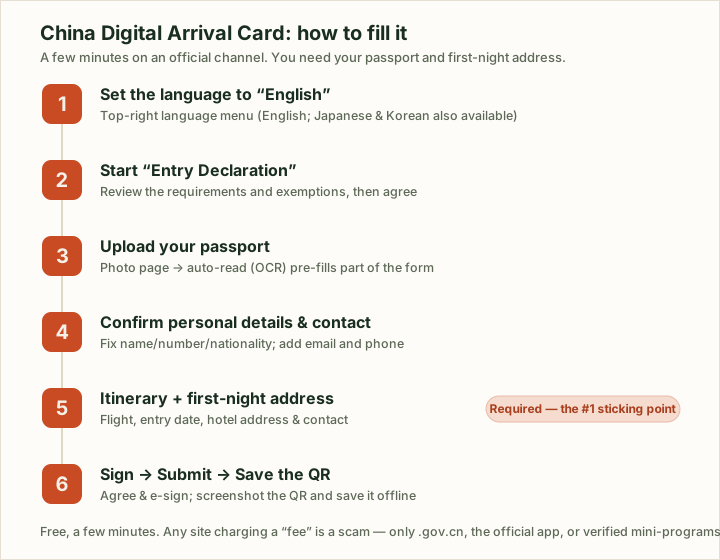
First, set the language to English using the menu in the top-right corner (the official form supports English; Japanese, Korean and other languages are also available). Then:
- Upload your passport photo page. The system auto-reads part of your details. If the scan looks wrong, type the details manually rather than forcing a blurry upload.
- Verify the auto-filled personal info (name, passport number, nationality, date of birth) and correct anything wrong. Keep the name order as close to the passport as the form allows.
- Add your contact details — email and a phone number.
- Enter your travel plans — flight/train number, date of entry, and your accommodation address (see the trap below).
- Sign and submit, then save the QR code (screenshot it and, ideally, take a photo print or save offline — you may not have signal at the border).
The whole thing takes a few minutes once your booking is in hand.
Scenario-by-scenario: what to do before you arrive
| Scenario | What to do |
|---|---|
| Normal tourist or business arrival by air | File the CDAC 24-72 hours before arrival; save the QR offline |
| 30-day visa-free entry | File the CDAC too — visa-free status does not exempt you |
| 240-hour transit and leaving the airport | File the CDAC, then bring your onward third-country ticket for the transit counter |
| International-to-international connection, staying airside | Usually exempt because you do not clear immigration |
| Hong Kong → Shenzhen / Macau → Zhuhai land entry | File the same CDAC before the land-border crossing |
| Cruise, same vessel in/out | Exempt under the same-vessel cruise category, but confirm with the cruise operator |
| Family trip | One CDAC per passport, including children |
| Group visa or group visa-free tour | Usually handled under the group category; confirm with the tour operator |
| Changed hotel, flight, or arrival port after filing | File a fresh card if the change is material; it is free and faster than arguing at the counter |
| Lost the QR screenshot before immigration | Reopen the official channel if you can; otherwise use the port kiosk / help desk as backup |
The accommodation-address trap
The address of your first night’s stay is a mandatory field. This catches out travelers who like to wing it, or who plan to book on arrival. Two ways through:
- Book your first night (even a cheap, free-cancellation room) before you file, so you have a real address to enter.
- If your plans genuinely aren’t fixed, enter the hotel you’re most likely to use; the card records your declared address, it isn’t a binding reservation.
If you later switch to a different hotel before arrival, the cleanest move is to submit a fresh card. The form is free; a new QR costs less than five minutes.
Corrections, changes, and “I forgot to file”
This is the part most official notices don’t explain in traveler language:
| Problem | What to do |
|---|---|
| You typed one passport digit wrong | File a new card through the official channel. Do not travel on a QR tied to bad passport data. |
| Your flight is delayed but the arrival port is the same | Keep the QR and bring the boarding pass / updated flight notice. If the date changes significantly, file again. |
| Your hotel changed before arrival | File again with the new first-night address. |
| You paid a third-party site | File again through NIA. The official QR, not the payment receipt, is what matters at the border. |
| You landed without filing | Use the QR code, smart device, kiosk, or paper backup at the port. Expect it to be slower. |
The official system is meant to reduce the queue, not create a trap. But border officers are checking a legal entry declaration, so don’t treat wrong data as “close enough” if you can fix it before inspection.
Visa-free and transit travelers: you still need it
This is the single most-asked question online, so to be unambiguous: if you enter under visa-free rules or the 24/144/240-hour visa-free transit scheme and you leave the airport, you must complete the CDAC. It’s the same form — there is no separate transit version. Only passengers who remain in the airside transit area without clearing immigration are exempt. At the transit-without-visa (TWOV) counter you still present passport + onward ticket as before; the arrival card is now just done online beforehand.
Land borders and Hong Kong → Shenzhen
The card applies at land and rail crossings, not only airports. Travelers crossing from Hong Kong into Shenzhen (Luohu, Futian and other ports) report completing the same digital card and showing the QR at immigration. If you’re doing a HK–mainland day trip or a rail entry, treat it exactly like an air arrival.
Traveling as a family or couple
Each traveler needs their own arrival card — it’s tied to an individual passport. If you’re traveling as a family, complete one per person (including children on their own passports). One adult can help fill the cards for everyone, but the output should be separate QR codes: one passport, one QR.
Group-tour travelers on a collective visa are the exception: the group operator handles entry formalities, so individual filing usually isn’t required. If you’re simply a group of friends booking the same flights and hotels, that is not a “group visa” in this sense; file individually.
What the CDAC does NOT do
- It is not a visa and not an entry permit. You still need a valid visa, or to qualify for visa-free/transit entry. Filing the card does not grant you permission to enter.
- It does not get you online. You’ll want data the moment you land — to show the QR, call a Didi, or open a map. Sort that out before you fly: see the best eSIM for China.
- It does not set up payments. You still need Alipay or WeChat Pay for daily spending.
If you haven’t checked whether you even need a visa, start with our China visa-free entry guide.
Save-this checklist before you leave for the airport
- Passport photo page ready.
- Flight, train, ferry, or land-crossing entry details ready.
- First-night hotel name and address ready.
- Contact email and phone number ready.
- Official NIA channel opened; no payment page, no agency site.
- CDAC submitted and QR code saved as a screenshot.
- QR code available offline on your phone.
- Backup: passport, hotel booking, onward ticket, and QR screenshot saved in one offline folder.
- Transit travelers: onward third-country ticket saved separately for the transit counter.
- Family travelers: one QR per traveler, not one QR for the group.
Frequently asked questions
Is the China Digital Arrival Card mandatory in 2026? Yes. Since 20 November 2025 it is required for nearly all foreign visitors entering mainland China, with seven narrow exempt categories (permanent residents, airside transit passengers, group travelers, and a few others).
How much does it cost? Nothing. The official arrival card is free. Any “fee” means you’re on a scam site.
How early can I fill it out? The recommended window is 24–72 hours before arrival. File it the day before on reliable Wi-Fi rather than relying on in-flight internet.
Do I need it for a 240-hour visa-free transit? Yes, if you leave the airport. It’s the same form as a normal arrival, not a separate transit document.
Does it replace my visa? No. It’s an arrival declaration, not permission to enter. You still need a valid visa or visa-free eligibility.
Can one person fill it out for the whole family? No — each passport needs its own card. Complete one per traveler.
Is the China arrival card per person or per family? Per person. The card is tied to one passport, so a couple, family, or group of friends should submit one arrival card for each traveler. Children need their own card too if they are entering on their own passport.
How long is the China Digital Arrival Card valid? Use it for the specific arrival you filed. Treat the QR code as trip-specific: if your flight, arrival port, or first-night address changes materially, file a fresh card rather than trying to reuse an old one.
Can I fill out the China arrival card 2 hours before arrival? Usually yes if you have internet and your passport / accommodation details ready, but it is a bad plan. The low-stress window is still 24-72 hours before arrival, because in-flight Wi-Fi, airport roaming, low battery, and queue pressure are exactly where travelers get stuck.
Do I still need to go to an airport kiosk after submitting the QR code online? Normally no. Save the QR code offline and show it at immigration if asked. Kiosks are mainly a backup for travelers who did not file online, need to correct something, or cannot retrieve their QR code.
Is the China arrival card free, or is there a service fee? It is free. If a site asks you to pay a “service fee” or “processing fee” just to submit the arrival card, close it and use the official NIA channel instead.
What if I didn’t do it before landing? There are kiosks, scannable QR codes, and (during the rollout) paper forms at ports of entry. It’s slower, but you won’t be turned away for not having done it online.
Can someone else fill out the China arrival card for me? Yes. A parent, spouse, travel agent, or friend can help enter the data, but the card is still tied to one traveler’s passport. Check every passport number and name before submission.
Do I need the CDAC for Hong Kong to Shenzhen or Macau to Zhuhai? Yes if you clear mainland immigration. The same digital arrival card applies at land and rail ports, not just airports.
What if my first hotel changes after I submit the card? If the change happens before you enter mainland China, file a fresh card with the new first-night address. It is free and avoids a mismatch at inspection.
Is a screenshot enough, or do I need to print the QR code? A screenshot is usually the practical minimum. If you’re worried about battery, roaming, or an older phone, print it or save it on a second device as a backup.
Sources
- Notice on Online Arrival Card Filling for Foreign Nationals — National Immigration Administration, official
- Beware of Fraudulent Websites Imitating China’s Arrival Card Filling Service — National Immigration Administration, official
- Arrival Card Filling (desktop portal) — s.nia.gov.cn, official
- China Launches Online Arrival Card for Foreign Nationals — Embassy of China in the United States, official notice
Affiliate link — we may earn a commission at no extra cost to you. Booking is completed on Klook.