Layover planner
Shanghai layover from Pudong: 4 to 12-hour plans
Plan a 4, 6, 8, 10 or 12-hour Shanghai Pudong layover with entry-permit checks, realistic city routes, airport transfers, luggage and return buffers.
Plan a Pudong layover backwards from the next flight’s boarding time. First remove immigration, baggage, both airport transfers, security and the walk to the gate. The time left is your Shanghai visit.
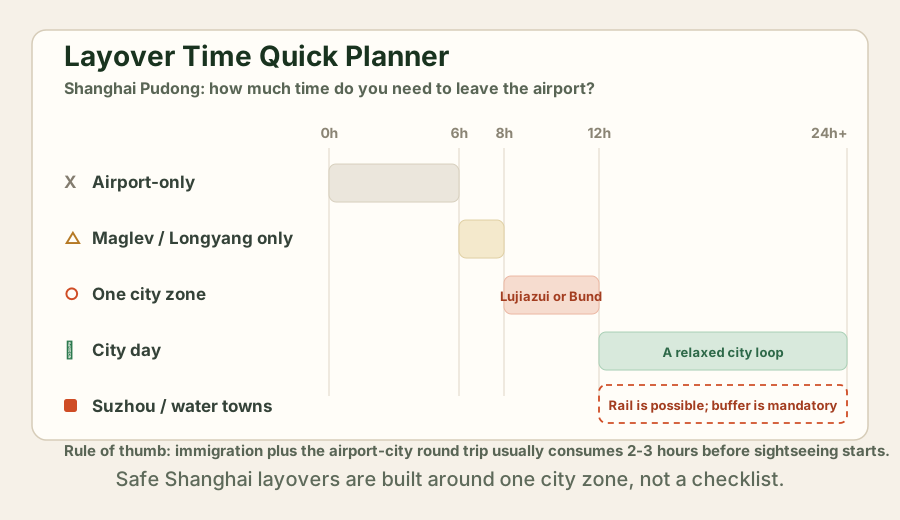
Pudong has Metro Line 2 and the Maglev to Longyang Road, but neither puts you straight onto the Bund. Six hours is usually airport time. Eight hours may allow Lujiazui. Ten to twelve hours gives you more room, provided entry and baggage are straightforward.
Calculate the hours you can actually use
Write down the next flight’s boarding time, not only its departure time, then count backwards.
| Time to remove | What it includes |
|---|---|
| Arrival to landside | Taxiing, walking, immigration or a temporary-entry application, and baggage if it is not checked through |
| Airport to first stop | Finding the station or pickup point plus the full ride to Lujiazui or central Shanghai |
| Return to the gate | City-to-airport travel, terminal check-in or bag drop, exit control, security and the walk to the gate |
| Disruption reserve | Inbound delay, queues, a missed train, traffic or a terminal mistake |
If removing those blocks leaves less than about two hours in the city, stay at the airport. A driver can reduce transfers and wayfinding; allow the same time for border, baggage and security queues.
The buffer rule for Pudong
For international layovers, aim to be back at Pudong about 3 hours before departure, earlier if you still need to check in or re-check bags. This buffer covers the terminal transfer, exit formalities, security and the walk to the gate.
If your checked bag is not tagged through to the final destination, add time to collect and re-check it before security. Ask the airline at the first airport where you will next see the bag.
Can you leave Pudong Airport during a layover?
Yes, if immigration admits you. Your airline ticket itself usually does not forbid you from leaving the airport, but a short connection does not automatically give permission to enter China. You may use ordinary visa-free entry, the 240-hour transit policy, a regular visa or—on an eligible sub-24-hour transit—a temporary entry permit issued at the port.
The official 24-hour rule allows direct airside transit without border inspection at Pudong for eligible interline passengers. If you want to leave the restricted transit area, you must request temporary entry; issuance is not guaranteed. Keep the onward confirmed ticket, passport and hotel/day-plan details available, and treat the city itinerary as conditional until immigration admits you.
If you are using the 240-hour transit scheme, confirm that your route is a genuine third-country transit. Our 240-hour transit checker is the right first step before planning any city run.
4-hour Shanghai layover
Stay airside. Four hours is enough for a transfer, food, a lounge, or a shower, but not for Shanghai. Even if immigration is fast, the useful city time after round-trip transport will be too small.
Use this time to solve practical things instead: connect your China eSIM, check whether your apps work, and make sure your next boarding pass and onward ticket are ready.
6-hour Shanghai layover
Six hours is not enough for a worthwhile central-Shanghai visit after entry, round-trip transport and re-security. Stay at the airport. A Maglev out-and-back adds ticketing and missed-connection risk without giving you a meaningful city stop.
Use the time for a meal, shower or lounge, and confirm the onward gate and boarding pass. If the six hours are overnight, sleep is usually worth more than a roadside view from a taxi.
8-hour Shanghai layover
Eight hours can work, but keep the target tight. The cleanest route is Pudong Airport → Maglev or Metro Line 2 → Lujiazui. Walk the elevated paths, see the Oriental Pearl / Shanghai Tower skyline, take photos, eat something simple, then return.
An international-to-international eight-hour transfer is tight once entry, baggage, round-trip transport and re-security are included. If the inbound flight is late or immigration is slow, cancel the city stop.
An 8-hour decision route
- Clear immigration or receive the temporary entry permit.
- Confirm that bags are checked through or stored and that the next boarding pass is ready.
- Set a non-negotiable airport-return time in your phone.
- Travel to Lujiazui and stay on the Pudong side of the river.
- Leave for PVG when the return alarm sounds, even if food or photos are unfinished.
Do not prebook a timed attraction for this plan. A skyline walk is easy to shorten; an observation-deck reservation is not.
10-hour Shanghai layover
Ten hours is the first comfortable city layover. Start in Lujiazui, then cross or ride toward Nanjing East Road and the Bund if your clock still looks healthy. This gives you the two classic Shanghai views: futuristic Pudong towers and the historic Bund frontage.
Skip Yu Garden, museums, Xintiandi and a river cruise on the same layover. Choose one addition after Lujiazui and leave when the return alarm sounds.
12-hour Shanghai layover
Twelve hours supports a simple east-to-west route if arrival formalities go well:
PVG → Lujiazui → ferry or metro across the river → Bund / Nanjing East Road → PVG.
Have one meal near the route and keep attractions optional. If the inbound flight is late, drop the Bund and use the eight-hour Lujiazui plan. If weather hides the skyline, replace the outdoor walk with a meal or one indoor stop rather than crossing Shanghai for a second itinerary.
For a daytime stop with checked-through bags, airport luggage delivery or storage can preserve useful city time. For a group, children, reduced mobility or several suitcases, a pre-arranged airport transfer may be easier than Maglev-plus-metro changes. Neither service changes the immigration decision or the airport return deadline.
Maglev vs Metro Line 2
The official airport page confirms Pudong Airport is served by Metro Line 2, which connects onward toward the city and Hongqiao. The Maglev is faster between Pudong Airport and Longyang Road — roughly 8 minutes — but you still need a transfer after Longyang Road for most city sights. For the full airport-to-city comparison, see Shanghai Pudong Airport to City: Maglev vs Metro vs Taxi.
| Option | Best for | Trade-off |
|---|---|---|
| Maglev + metro/taxi | 8-10 hour layovers, Lujiazui snapshot | Fast first leg, but requires transfer |
| Metro Line 2 all the way | Budget route, simple navigation | Slower from PVG to central Shanghai |
| Taxi / ride-hailing | Late-night or group travel | Traffic risk and payment setup matter |
What to do if your layover is overnight
For a late arrival, check train times before committing to the city. If rail is closed, take a taxi to a hotel around Lujiazui, Nanjing East Road or Century Avenue, or stay near Pudong Airport. On a short overnight, use the option that leaves the longest uninterrupted sleep window.
The next morning, return early. Morning airport runs can be smooth, but the cost of being wrong is high.
Airport hotel, city hotel or lounge?
| Situation | Better default |
|---|---|
| You must remain airside or entry is uncertain | Ask the airline about airside transfer facilities; do not book a public-area hotel you may not be able to reach |
| Less than one useful sleep cycle | Lounge or terminal rest, subject to opening hours and concourse access |
| Landside overnight with an early flight | Pudong airport hotel with a verified terminal walk or shuttle |
| Long overnight and next flight is later in the day | Central hotel only if two extra airport transfers still leave enough sleep and buffer |
Common mistakes
- Treating “8 hours between flights” as “8 hours in Shanghai.”
- Choosing the Bund first, then discovering the return route is slower than expected.
- Forgetting that international re-security and exit control take time.
- Planning around attractions with fixed tickets or long queues.
- Ignoring luggage. A roller bag turns a quick skyline walk into a chore.
Sources
- Shanghai Airport — rail transit from Pudong Airport
- Shanghai Maglev official site
- National Immigration Administration — 24-hour and 240-hour transit policy
- Local Chinese traveler discussions were used as background research for practical timing, luggage and “should I leave the airport” judgments; they are not linked here because final facts are verified against official transport and immigration sources.
Affiliate link — we may earn a commission at no extra cost to you. Booking is completed on Klook.