Visa or 240-hour transit
Do US citizens need a visa for China?
US passport holders are NOT covered by China's 30-day visa-free scheme — a point many travel blogs get wrong. You need either a tourist (L) visa or the 240-hour transit route. Here's how to choose.
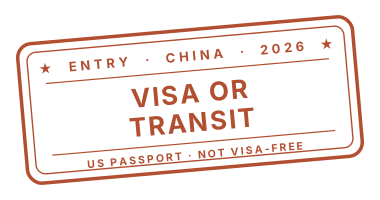
If you hold a US passport, here’s the blunt version: you are not on China’s 30-day visa-free list. Plenty of blog posts and even some travel-agency pages say Americans can “just turn up” for 30 days — that is wrong, and acting on it can get you denied at the airline check-in desk. What’s actually true is that the US sits outside the unilateral visa-free scheme but still has two legitimate ways in. This page walks through both so you can pick the right one before you book anything.
Why the confusion happens
China expanded visa-free entry aggressively in 2024–2026, and a lot of the coverage was sloppy. There are really three separate programs that constantly get blended together:
- The unilateral 30-day visa-free list — 50-odd countries whose citizens enter the mainland with no visa. The US is not on it.
- The 240-hour visa-free transit — a transit concession for people flying onward to a third place. The US is on this one.
- Hainan’s own 30-day visa-free entry — for the island province only, and it does include Americans.
When a blog says “Americans are visa-free,” it’s almost always confusing program 2 or 3 with program 1. They are not interchangeable. Get the distinction right and the rest is easy.
Option A — the tourist (L) visa: best if you’ll ever come back
For an ordinary leisure trip into Beijing, Shanghai, Chengdu or anywhere else on the mainland, the standard route is the L visa. The reason most Americans don’t mind the paperwork is reciprocity: the US and China issue each other 10-year, multiple-entry tourist visas. You do the application once and it covers a decade of trips, with the permitted length of each stay printed on the visa itself.
How it works in practice:
- Fill out the online form first (the COVA system). It’s long; budget an hour and have your travel history handy.
- Book an appointment at a Chinese Visa Application Service Center (CVASC). There are centers in Washington DC, New York, Los Angeles, San Francisco, Chicago and Houston.
- Go in person — fingerprints are collected on site for most applicants, so you generally can’t do the whole thing by mail.
- Bring a passport valid 6+ months with blank pages, the printed application, a photo to spec, and your flight and hotel bookings.
Plan on roughly four working days for standard processing, longer in peak season. The L category is simply China’s tourist visa, and the Chinese Visa Application Service Center is the official channel that handles it — that’s the body you’ll deal with, not a third-party agent.
A practical tip: because it’s a 10-year visa, apply even if your first trip is short. The second and third trips then cost you nothing but the flight.
Option B — 240-hour transit: only if you’re going onward
If China is a stop on the way to somewhere else — say you’re flying New York → Shanghai → Tokyo — you can use the 240-hour (10-day) visa-free transit and skip the visa entirely. The US is one of the ~55 eligible nationalities.
“Foreign travellers in transit must hold a connecting ticket to a third country or region, with a confirmed date and seat, departing within 240 hours.” — National Immigration Administration transit policy
The conditions are strict, though, and missing one means you’re turned away:
- You must have a confirmed onward ticket to a different country or region, departing within 240 hours. Connecting back to the US doesn’t count — it has to be a genuine third destination (Tokyo, Seoul, Bangkok and Singapore are common ones; Hong Kong and Macau also qualify as onward regions).
- You enter through one of the ~60 designated ports (all the big airports — Beijing, Shanghai, Guangzhou, Chengdu, Xi’an — qualify).
- The 240-hour clock starts when you clear immigration, not when you land. People miss this and overstay by hours.
- A few regions (Tibet, Xinjiang) are outside the transit zone and need separate permits.
This is excellent for a long layover you want to turn into a few days in Shanghai. It’s the wrong tool for a two-week multi-city holiday with a round-trip ticket home — for that, get the visa.
US visa vs 240-hour transit, at a glance
| Tourist (L) visa | 240-hour transit | |
|---|---|---|
| Need to apply in advance? | Yes (CVASC, in person) | No |
| Max stay | Printed on visa; 10-year multi-entry common | 10 days (240 hours) |
| Onward third-country ticket? | Not required | Required |
| Round-trip home ticket OK? | Yes | No |
| Best for | Any normal holiday, repeat visits | A layover you want to extend |
Before you fly: the easy things people forget
- Get the China Digital Arrival Card done online before you land — it replaces the old paper form and clears immigration faster.
- Sort out connectivity and payments in advance. Most US phone plans don’t roam usefully in China, and Western credit cards aren’t widely accepted. A travel eSIM for China plus Alipay set up for a foreign card solves both before you arrive.
- Don’t book non-refundable flights until your visa is in hand if you’re going the L-visa route.
Once entry is sorted, the next thing worth getting right is timing — see the best time of year to visit China, then start with Beijing or Shanghai.
Other nationalities
Hold a different passport? The rules vary a lot by country:
- United Kingdom — visa-free since February 2026
- Canada — visa-free since February 2026
- Australia — visa-free, 30 days
- India — visa required
- The two visa-free schemes, fully explained
Last verified: 14 June 2026. Visa and transit rules change frequently and can vary by where you apply. This is a general guide, not legal advice — always confirm your own case with the National Immigration Administration or your nearest Chinese embassy or visa center before booking travel.
Affiliate link — we may earn a commission at no extra cost to you. Booking is completed on Klook.