 Water 水
 Recent Ox years — every 12, with their element:
- 1961 Metal
- 1973 Water
- 1985 Wood
- 1997 Fire
- 2009 Earth
- 2021 Metal
- 2033 Water next
Born in January or early February? Your sign may differ — check your exact date →
Which years are the Year of the Ox, what an Ox is like, best & worst matches, lucky numbers — plus the 'willing-ox' work ethic, why the Ox came second in the Great Race, and when the next Ox year (2033) lands.
The Ox is the second animal in the Chinese zodiac, and it carries the most flattering reputation of any sign: the dependable workhorse everyone wants on their team. The last Year of the Ox was 2021 (a Metal Ox); the next one is 2033, a Water Ox. If you were born in an Ox year, tradition casts you as the one who gets the job done without making noise about it — and there’s a famous origin story for exactly why the Ox finished second, not first, in the race that set the zodiac order. Here’s everything an Ox year actually means, and how to check whether you’re really one.
Which years are the Year of the Ox?
The Ox comes around every 12 years. Recent and upcoming Ox years, with the element each one carries (the element runs on a longer 60-year cycle, so no two consecutive Ox years share one):
| Ox year | Element | Runs from → to (lunar) |
|---|---|---|
| 1937 | Fire | — |
| 1949 | Earth | — |
| 1961 | Metal | — |
| 1973 | Water | — |
| 1985 | Wood | — |
| 1997 | Fire | — |
| 2009 | Earth | — |
| 2021 | Metal | — |
| 2033 | Water | Jan 31, 2033 → Feb 18, 2034 |
| 2045 | Wood | — |
One catch that trips people up: the zodiac year starts at Chinese New Year, not January 1. So if you were born in January or early February, you might belong to the previous animal (the Rat), not the Ox. Don’t guess — run your exact birth date through our Chinese zodiac calculator, which handles that boundary for you.
When is the next Year of the Ox?
The next Ox year is 2033, beginning at Chinese New Year on January 31, 2033 and running to February 18, 2034 (the day before the following New Year). It’s a Water Ox (癸丑 guǐchǒu) year — water softens the Ox’s famously stubborn streak into something more adaptable and intuitive, while keeping the underlying patience intact. A baby born in, say, March 2033 is a Water Ox; a baby born in mid-January 2033 is still a Tiger from the 2022 cycle’s successor year — actually a Rabbit’s neighbour, so check the calculator if you’re near the boundary.
The Ox personality
In the zodiac’s character sheet, the Ox is the steady one: diligent, dependable, patient, and strong-willed, with a quiet, methodical way of working through problems. Oxen are said to be the people who put their heads down and finish what they start, earning trust through consistency rather than charm. They value stability, honesty and a fair day’s work.
The flip side of all that reliability: Oxen are described as stubborn, slow to change their minds, and not great at small talk or office politics. They can be blunt to the point of seeming cold, and they’d rather grind through a problem alone than ask for help. The one-line version: an Ox would rather be right and unpopular than charming and wrong.
The five types of Ox
Because each Ox year carries one of the five elements, the “type” shades the base personality:
| Element | Ox years | What it adds |
|---|---|---|
| Wood | 1985 · 2045 | Cooperative, more flexible, team-minded |
| Fire | 1937 · 1997 | More intense and bold — drive with a temper |
| Earth | 1949 · 2009 | The steadiest of all — grounded and reliable |
| Metal | 1961 · 2021 | Driven, ambitious, unyielding |
| Water | 1973 · 2033 | Adaptable, intuitive, easier to work with |
2033 is 癸丑 — a Water Ox year, the softer, more flexible side of an otherwise stubborn sign.
Ox compatibility: best and worst matches
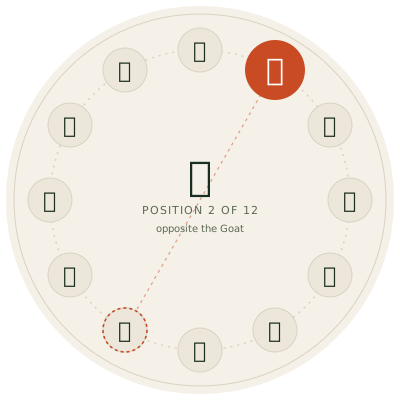
Traditionally, the Ox forms a harmonious trine with the Snake and the Rooster, and a classic “six-harmony” pairing with the Rat — fittingly, the very animal that beat it in the Great Race. Its hardest match is its clash animal, the Goat.
| Match | Animals | Why |
|---|---|---|
| Best | Snake, Rooster, Rat | Shared values and work ethic; trine + six-harmony |
| Tricky | Goat, Horse | Goat is the direct clash (丑未冲); Horse’s restlessness grates on the Ox’s love of routine |
As with all zodiac compatibility, treat this as cultural folklore and a fun icebreaker, not a relationship verdict — plenty of happy couples are “incompatible” on paper.
Lucky numbers, colours and things for the Ox
By tradition, the Ox’s lucky signals are:
- Lucky numbers: 1 and 4
- Lucky colours: white, yellow and green
- Lucky flowers: tulip and lucky bamboo
- Best avoided: the numbers 3 and 6, and the colour blue (in some readings)
These show up in everyday ways during an Ox year — you’ll see yellow-and-white New Year décor and ox motifs on everything from red envelopes to bank lobby displays, since the Ox is also a folk symbol of wealth and steady saving.
Famous people born in the Year of the Ox
A spread of Ox-year births across the decades — scroll the timeline:
 1901Walt DisneyStudio founder
 1937Morgan FreemanActor1949Meryl StreepActor
 1961Barack ObamaPresident
 1973Heidi KlumModel & host1985Keira KnightleyActor
 1985Michael PhelpsChampion swimmer
 1997Malala YousafzaiHumanitarian
 1997Naomi OsakaAthlete
A roster heavy on disciplined long-haul achievers — an Olympic-record swimmer, a Nobel laureate, two-term presidents and actors with decades-long careers — fits the Ox’s reputation for grinding out results over time rather than flaring up fast.
The willing-ox work ethic: why “老黄牛” is a compliment
If there’s one idea that defines the Ox in Chinese culture, it’s the 老黄牛 (lǎo huángniú, “old yellow ox”) — a phrase used to praise someone who works hard without complaint, takes on the heavy lifting, and never demands credit. Calling a colleague a 老黄牛 isn’t an insult about being slow; it’s high praise for being the dependable backbone of a team. The four-character idiom 任劳任怨 (rènláo-rènyuàn) — “to bear hardship and take blame without grumbling” — is practically the Ox’s official motto.
This runs deep because the ox was the engine of Chinese farming for thousands of years: it pulled the plough, turned the mill and hauled the cart, eating only grass and giving back milk, labour and — eventually — everything. The I Ching even pairs the ox with 坤 (kūn), the receptive earth trigram that “carries and nourishes all things.” So when tradition assigns Ox-born people the traits of patience, endurance and selfless effort, it’s drawing on a very old and very literal association: the animal that, more than any other, built the agricultural world.
Second by a whisker: the Ox and the Great Race
Here’s the story Chinese children grow up with. The Jade Emperor announced a race across a great river to decide the order of the zodiac — the first twelve animals across would each get a year. The Ox, strong and steady, waded in and quickly took the lead. But the clever Rat, unable to swim the deep water alone, had hitched a ride on the Ox’s back (in some versions, tucked behind its ear). Just as the Ox reached the far bank and was about to finish first, the Rat leapt off its head and scampered across the line ahead of it.
So the Ox came second — beaten not by strength but by cunning. The detail Chinese storytellers love is the Ox’s reaction: no anger, no protest. It simply accepted the result and went back to work. That’s the whole point of the tale — the Ox is so good-natured and unbothered by status that it carried the very animal that stole its first place, and held no grudge. It’s also why folk tradition pairs the Ox and Rat as one of the “six harmonies”: the Ox is happy to let the Rat take the spotlight while it does the steady work underneath.
The spring-ox ritual: whipping winter away on Lichun
There’s a centuries-old custom that puts the ox at the literal start of the farming year. On Lichun (立春) — the “Beginning of Spring” solar term, falling around February 4 — Chinese communities once held a ceremony called 鞭春牛 (biān chūnniú), “whipping the spring ox.” A life-sized ox was built from clay, bamboo or paper, and local officials would strike it with red-tasselled whips to “drive out winter’s laziness” and signal that ploughing season had begun.
It was equal parts ritual and festival: the figure was often stuffed with grain that spilled out when broken, a wish for a rich harvest, and the day included worship of Gou Mang (句芒), the god of spring. The practice has faded but isn’t gone — you can still catch revived 打春牛 (dǎ chūnniú) ceremonies in parts of Guangdong, Shandong and other rural regions around Lichun. It’s the clearest sign of how central the ox was to the Chinese agricultural calendar: not just a zodiac animal, but the symbol of the year’s first work.
What an Ox year means when you travel China

If you visit China during an Ox year, the animal is everywhere: ox figures and the character 牛 (niú) appear on shop windows, lanterns, stamps and mooncake tins, peaking around Chinese New Year. The next chance is early 2033, when the New Year lands on January 31. Wondering when to actually go? The weeks bracketing the New Year are the most festive and the most crowded — see our best time to visit China guide before you book, and sort out visas and an eSIM ahead of time.
Find your exact Chinese zodiac sign
Not sure if you’re an Ox — or curious what element and stem-branch year you were born under? Enter your birth date in our Chinese zodiac calculator; it accounts for the New Year boundary so you get the right animal, even for a January birthday.