 Wood 木
 Recent Rabbit years — every 12, with their element:
- 1963 Water
- 1975 Wood
- 1987 Fire
- 1999 Earth
- 2011 Metal
- 2023 Water
- 2035 Wood next
Born in January or early February? Your sign may differ — check your exact date →
Which years are the Year of the Rabbit, what a Rabbit is like, best & worst matches, lucky numbers — plus the Jade Rabbit moon legend and why Vietnam swaps the Rabbit for a Cat.
The Rabbit is the fourth animal in the Chinese zodiac, and it has one of the gentlest reputations on the wheel — calm, elegant and kind where the Tiger before it is all teeth. The last Year of the Rabbit was 2023, a Water Rabbit; the next one is 2035, a Wood Rabbit. If you were born in a Rabbit year, you’re the sign people describe as the diplomat of the cycle. Here’s what the Rabbit year actually means — including the Jade Rabbit on the moon and the quirk that turns the Rabbit into a Cat the moment you cross into Vietnam — and how to check whether you really are one.
Which years are the Year of the Rabbit?
The Rabbit comes around every 12 years. Recent and upcoming Rabbit years, with the element each one carries (the element runs on a longer 60-year cycle, so no two consecutive Rabbit years share one):
| Rabbit year | Element | Runs from → to (lunar) |
|---|---|---|
| 1939 | Earth | — |
| 1951 | Metal | — |
| 1963 | Water | — |
| 1975 | Wood | — |
| 1987 | Fire | — |
| 1999 | Earth | — |
| 2011 | Metal | — |
| 2023 | Water | — |
| 2035 | Wood | Feb 8, 2035 → Jan 27, 2036 |
| 2047 | Fire | — |
One catch that trips people up: the zodiac year starts at Chinese New Year, not January 1. So if you were born in January or early February, you might belong to the previous animal (Tiger), not the Rabbit. Don’t guess — run your exact birth date through our Chinese zodiac calculator, which handles that boundary for you.
When is the next Year of the Rabbit?
The next Rabbit year is 2035, a Wood Rabbit (乙卯 yǐmǎo). Counting from the last one in 2023, you have a wait — the Rabbit won’t headline the calendar again until the lunar new year that falls on February 8, 2035, running through January 27, 2036. A baby born in, say, March 2035 is a Wood Rabbit; a baby born in late January 2035 is still a Tiger from the 2034 year. The 2023–2035 gap is the standard 12-year cycle every animal follows.
The Rabbit personality
In the zodiac’s character sheet, the Rabbit is the gentle one: kind, elegant, gentle, quiet and refined, with good manners and a strong dislike of conflict. Rabbits are described as patient listeners and natural peacemakers who read a room well and rarely raise their voice.
The flip side of all that calm: Rabbits are described as cautious, conflict-averse and sometimes too eager to please — they can retreat rather than confront, sit on a decision too long, or smooth over a problem instead of fixing it. The one-line version: a Rabbit would rather keep the peace than win the argument.
The five types of Rabbit
Because each Rabbit year carries one of the five elements, the “type” shades the base personality:
| Element | Rabbit years | What it adds |
|---|---|---|
| Wood | 1975 · 2035 | Cooperative, easier-going, team-minded |
| Fire | 1987 · 2047 | The most intense — warmer, bolder, more outgoing |
| Earth | 1939 · 1999 | Steadier, more grounded and reliable |
| Metal | 1951 · 2011 | Driven, ambitious, more strong-willed |
| Water | 1963 · 2023 | Adaptable, sensitive, a smooth communicator |
2035 is 乙卯 — a Wood Rabbit year, the next one on the calendar.
Rabbit compatibility: best and worst matches
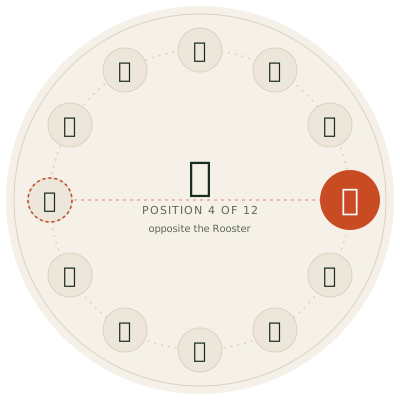
Traditionally, the Rabbit forms a harmonious trine with the Goat and the Pig, and a classic “six-harmony” pairing with the Dog. Its hardest match is its direct opposite on the wheel, the Rooster.
| Match | Animals | Why |
|---|---|---|
| Best | Goat, Pig, Dog | Shared calm and values; trine + six-harmony |
| Tricky | Rooster, Rat | Rooster is the direct clash (卯酉冲); Rat grates on the Rabbit’s need for harmony |
As with all zodiac compatibility, treat this as cultural folklore and a fun icebreaker, not a relationship verdict — plenty of happy couples are “incompatible” on paper.
Lucky numbers, colours and things for the Rabbit
By tradition, the Rabbit’s lucky signals are:
- Lucky numbers: 3, 4 and 6
- Lucky colours: pink, red and purple
- Lucky flowers: plantain lily and jasmine
- Best avoided: the numbers 1 and 7 and the colours dark brown and dark yellow
These show up in everyday ways during a Rabbit year — you’ll see pink-and-purple New Year décor and rabbit motifs on everything from red envelopes to luxury-brand capsule collections.
Famous people born in the Year of the Rabbit
A spread of Rabbit-year births across the decades — scroll the timeline:
 1939Lily TomlinActor
 1951Bonnie TylerSinger
 1963Michael JordanAthlete
 1963Pan ShiyiBusiness leader
 1975Angelina JolieActor1975Tiger WoodsAthlete1975Charlize TheronActor1987Lionel MessiAthlete1987Blake LivelyActor
A roster that mixes quiet diplomats with steely competitors fits the Rabbit’s “gentle but underestimate-me-at-your-peril” reputation.
The Jade Rabbit on the moon
The single most famous piece of Rabbit folklore in China isn’t about the zodiac at all — it’s the Jade Rabbit (玉兔 Yùtù), the white rabbit who lives on the moon. In the best-known version, the Jade Emperor disguised himself as a starving old man and begged food from the animals; the monkey brought fruit and the fox brought fish, but the rabbit, having nothing, leapt into the fire to offer itself. Moved by the sacrifice, the emperor placed the rabbit on the moon, where it became the companion of the moon goddess Chang’e and now spends eternity pounding the elixir of immortality (玉兔捣药) with a mortar and pestle.
This is why the rabbit became a poetic stand-in for the moon itself in classical Chinese: the poet Li Bai wrote of the “white rabbit pounding medicine,” and the image of the moon-rabbit shows up on Han-dynasty bronze mirrors and silk paintings more than two thousand years ago. During the Mid-Autumn Festival you’ll still meet the rabbit everywhere — pressed into mooncakes, and as Lord Rabbit (兔儿爷, Tù’éryé), a clay rabbit-deity figurine that Beijing families have bought for the festival since the Ming dynasty to wish for health. China even named its first lunar rover Yutu (“Jade Rabbit”) in 2013. So in Chinese culture the rabbit carries a triple load of meaning the Western Easter bunny never had: the moon, longevity, and gentle good fortune.
In Vietnam, the Rabbit is a Cat
Cross the border into Vietnam and the fourth zodiac animal isn’t a rabbit at all — it’s a cat. The Vietnamese celebrate the Year of the Cat (Mèo) in exactly the years China and the rest of the Sinosphere keep the Rabbit, which means 2023 was the Year of the Water Cat in Hanoi and the Year of the Water Rabbit in Beijing.
The most-cited explanation is linguistic: the classical Chinese name for the Rabbit’s earthly branch is 卯 (mǎo), which sounds almost identical to mèo, the Vietnamese word for cat — so as the system was passed along orally, the rabbit quietly became a cat. There’s a cultural logic to why it stuck, too: rabbits were uncommon in rural Vietnam, while cats earned their keep guarding rice stores from rats, making the cat the more meaningful household animal. Whatever the cause, it’s one of the clearest examples that the “Chinese zodiac” isn’t uniform across Asia — each culture adapted it. (Korea and Japan, for the record, keep the Rabbit.)
Is the Rabbit lucky or just timid?
The Rabbit’s gentleness gets it unfairly typecast as weak, but Chinese tradition reads it differently. The white rabbit was a 祥瑞 (xiángruì) — an auspicious omen — precisely because it was rare; old texts claimed a rabbit only turned pure white after living five hundred years, tying it to longevity. The rabbit’s famous fertility (“吐子”, a homophone for “spitting out children”) made it a symbol of a thriving, many-childrened family. And its watchfulness — long ears for listening, big eyes for seeing — was read as prudence, not fear. So the cultural verdict on a Rabbit is closer to quietly fortunate and quick to sense trouble than timid — a useful corrective if you’ve only ever heard the sign described as shy.
Lord Rabbit and the Mid-Autumn Festival
If you visit China in autumn rather than at Lunar New Year, the Rabbit you’ll actually run into is Lord Rabbit (兔儿爷), the painted clay figurine sold around the Mid-Autumn Festival. He’s depicted as a rabbit with a human face, often seated on a lion or tiger and holding a pestle — a nod straight back to the Jade Rabbit pounding medicine on the moon. Beijing’s old hutong shops and craft markets still sell them every September, and they’ve become one of the city’s signature folk souvenirs. It’s a neat reminder that the rabbit’s cultural weight in China is split across two festivals: the zodiac rabbit belongs to Lunar New Year, while the moon rabbit belongs to Mid-Autumn.
When does the Rabbit year actually start?
Every Chinese zodiac year begins on Chinese New Year, which falls on a different date each year between late January and late February — never January 1. The 2035 Rabbit year, for instance, starts on February 8, 2035. This boundary is the single biggest source of zodiac mistakes: anyone born in January or the first days of February sits in the previous animal’s year. If your birthday lands in that window, the safest move is to check the exact lunar date rather than assume from the Gregorian year.
What a Rabbit year means when you travel China

During a Rabbit year the animal is unavoidable — rabbit figures and the character 兔 (tù) appear on shop windows, lanterns, stamps and mooncake tins, peaking around Chinese New Year. Even outside a Rabbit year, you’ll meet the Jade Rabbit on mooncake boxes every Mid-Autumn. Wondering when to actually go? The weeks bracketing the New Year are the most festive and the most crowded — see our best time to visit China guide before you book, and sort out visas and an eSIM ahead of time.
Find your exact Chinese zodiac sign
Not sure if you’re a Rabbit — or curious what element and stem-branch year you were born under? Enter your birth date in our Chinese zodiac calculator; it accounts for the New Year boundary so you get the right animal, even for a January birthday.