 Earth 土
 Recent Rooster years — every 12, with their element:
- 1957 Fire
- 1969 Earth
- 1981 Metal
- 1993 Water
- 2005 Wood
- 2017 Fire
- 2029 Earth next
- 2041 Metal
Born in January or early February? Your sign may differ — check your exact date →
Which years are the Year of the Rooster, what a Rooster is like, best & worst matches, lucky numbers — and why the next Rooster year is 2029 (an Earth Rooster), plus the rooster's old role as a dawn-crowing demon-chaser.
The Rooster is the tenth animal in the Chinese zodiac, and the next Rooster year arrives in 2029 — an Earth Rooster. Of all twelve signs the Rooster is the one most tangled up with everyday Chinese custom: its dawn crow was the village alarm clock, its picture went on the door to scare off ghosts, and the very word for it, 鸡 (jī), sounds like the word for “lucky” (吉, jí). If you were born in a Rooster year, here’s exactly what the sign means — and how to be sure you really are one, since the New Year boundary trips a lot of people up.
Which years are the Year of the Rooster?
The Rooster comes around every 12 years. Recent and upcoming Rooster years, with the element each one carries (the element runs on a longer 60-year cycle, so no two consecutive Rooster years share one):
| Rooster year | Element | Runs from → to (lunar) |
|---|---|---|
| 1933 | Water | — |
| 1945 | Wood | — |
| 1957 | Fire | — |
| 1969 | Earth | — |
| 1981 | Metal | — |
| 1993 | Water | — |
| 2005 | Wood | — |
| 2017 | Fire | — |
| 2029 | Earth | Feb 13, 2029 → Feb 2, 2030 |
| 2041 | Metal | — |
One catch that trips people up: the zodiac year starts at Chinese New Year, not January 1. So if you were born in January or early February, you might belong to the previous animal (the Monkey), not the Rooster. Don’t guess — run your exact birth date through our Chinese zodiac calculator, which handles that boundary for you.
Is 2029 a Year of the Rooster?
Yes — it’s the next one. The 2029 Rooster year runs from Chinese New Year on February 13, 2029 to February 2, 2030 (the day before the following New Year). Specifically it’s an Earth Rooster (己酉 jǐyǒu) year, the steadier, more grounded flavour of the sign. A baby born in, say, March 2029 is an Earth Rooster; a baby born in late January 2029 is still a Monkey from the 2028 year. The most recent Rooster year before that was 2017 (a Fire Rooster), and the one before that 2005 (a Wood Rooster).
The Rooster personality
In the zodiac’s character sheet, the Rooster is the sharp-eyed perfectionist: observant, hardworking, confident, and frank. Roosters are said to notice the detail everyone else missed, to keep their word, and to show up on time — the sign’s headline virtue is reliability. They like order, they like a plan, and they’re happy to tell you exactly what they think.
The flip side: that same precision tips into being blunt, critical, and a touch vain. Roosters can be know-it-alls who’d rather be right than tactful, and their high standards make them hard to please — including with themselves. The one-line version: a Rooster will tell you the truth before you’re ready to hear it, then be quietly hurt you didn’t thank them for it.
The five types of Rooster
Because each Rooster year carries one of the five elements, the “type” shades the base personality:
| Element | Rooster years | What it adds |
|---|---|---|
| Wood | 1945 · 2005 | Cooperative, easier-going, team-minded |
| Fire | 1957 · 2017 | The most intense — driven, magnetic, headstrong |
| Earth | 1969 · 2029 | Steadier, more grounded and reliable |
| Metal | 1981 · 2041 | Driven, ambitious, blunt |
| Water | 1933 · 1993 | Adaptable, restless, a smooth talker |
The next Rooster year, 2029, is 己酉 — an Earth Rooster, the grounded type.
Rooster compatibility: best and worst matches
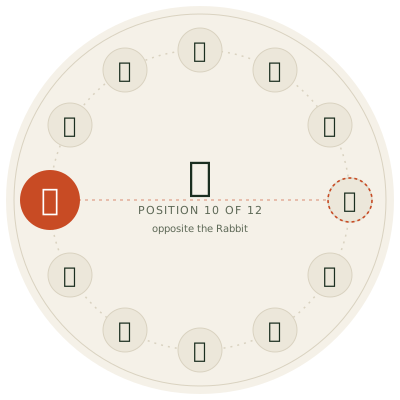
Traditionally, the Rooster forms a harmonious trine with the Ox and the Snake, and a classic “six-harmony” pairing with the Dragon. Its hardest match is its direct opposite on the wheel, the Rabbit.
| Match | Animals | Why |
|---|---|---|
| Best | Ox, Snake, Dragon | Shared discipline and ambition; trine + six-harmony |
| Tricky | Rabbit, Dog, Rooster | Rabbit is the direct clash (卯酉冲); two Roosters out-criticise each other |
As with all zodiac compatibility, treat this as cultural folklore and a fun icebreaker, not a relationship verdict — plenty of happy couples are “incompatible” on paper.
Lucky numbers, colours and things for the Rooster
By tradition, the Rooster’s lucky signals are:
- Lucky numbers: 5, 7 and 8
- Lucky colours: gold, brown and yellow
- Lucky flowers: gladiolus and cockscomb (the crest-shaped 鸡冠花, literally “rooster-comb flower”)
- Best avoided: the numbers 1, 3 and 9, and the colours red and white
These show up in everyday ways during a Rooster year — gold-and-brown New Year décor, and rooster motifs on everything from paper-cuts and red envelopes to mooncake tins.
Famous people born in the Year of the Rooster
A spread of Rooster-year births across the decades — scroll the timeline. (Each was born after their year’s Chinese New Year, so the sign holds.)
 1933Karl LagerfeldDesigner
 1945Aung San Suu KyiStateswoman
 1957Hans ZimmerComposer
 1969Jay-ZMusician1981BeyoncéMusician
 1981Serena WilliamsAthlete1981Roger FedererAthlete1993Ariana GrandeMusician1993Niall HoranMusician
A roster heavy on performers, perfectionist designers and record-breaking athletes fits the Rooster’s exacting, never-quite-satisfied streak.
If you’re a Rooster, watch the běnmìngnián
Whenever your own animal’s year comes back around — for Roosters, next in 2029 — that’s your 本命年 (běnmìngnián), and tradition treats it as one of the riskier years, not the luckiest. The idea is that you’ve come full circle and “offended” Tai Sui, the god of the year, leaving you more exposed to bad luck.
The standard remedy is to wear red next to the skin — red underwear, socks or a belt, classically given to you by an older relative — put on from New Year’s Eve and kept up through at least the first days of the new year. Note the small irony for Roosters: red is on the sign’s “avoid” colour list, but the běnmìngnián red rule overrides that — here the red is protective, not decorative. If you’re in China around a Rooster New Year and notice racks of red undergarments by every supermarket checkout, this is why.
The rooster as China’s original alarm clock — and ghost-chaser
Here’s the bit that makes the Rooster different from every other sign: it earned its reputation from a real job. Before clocks, the rooster’s dawn crow was the village’s timekeeper — Chinese sources call the bird 司晨, “the one in charge of the morning.” That single habit generated a whole cluster of meaning: punctuality, diligence, and the idiom 闻鸡起舞 (wén jī qǐ wǔ), “rise and train your sword at the cock’s crow,” still hung in studies today as a byword for discipline.
The same crow made the rooster a ghost-chaser. Folk belief held that ghosts can only move in the dark and must scurry back before daybreak; because the rooster’s crow announces the dawn, it came to “drive off” them. Classical sources push this further into myth: the 重明鸟 (chóngmíng niǎo), a rooster-like bird with double pupils, and the 金鸡 (jīn jī), “golden rooster,” that sits atop the cosmic peach tree and crows the sun up each morning, scattering evil spirits as the light spreads. The ancient almanac Jingchu Suishiji records that on the first day of the lunar year people would paste a picture of a rooster on the door, a custom older than the familiar door-gods. In Shanxi some households still hang a red paper-cut rooster (鸡符) instead.
Two more threads worth knowing:
- The five virtues (五德). A Han-dynasty text, the Han Shi Wai Zhuan, graded the rooster a “virtuous fowl” with five merits: 文 (refinement, for its crown-like comb), 武 (valour, for the spurs on its legs), 勇 (courage, for fighting all comers), 仁 (benevolence, for calling the flock to share food), and 信 (trustworthiness, for crowing on time without fail). It’s why a rooster painting reads, to a Chinese eye, as a wish for upright character — not just luck.
- The pun stack. 鸡 (jī) is a near-homophone of 吉 (jí), “auspicious,” so a big rooster picture means 大吉大利 (dàjí dàlì), “great luck, great profit.” Better still, a rooster beside cockscomb flowers means promotion — because the comb, 鸡冠 (jīguān), puns on 官 (guān), “official.” A whole little visual language is hiding in one bird.
So when you see roosters everywhere in a Rooster year, it isn’t just zodiac branding — it’s a 2,000-year-old symbol doing several jobs at once: clock, guard, and good-luck charm.
What the Rooster year means when you travel China

If you visit China during a Rooster year, the animal is everywhere — rooster figures and the character 鸡 (jī) on shop windows, lanterns, stamps, paper-cuts and mooncake tins, peaking around Chinese New Year (February 13, 2029 for the next one). Wondering when to actually go? The weeks bracketing the New Year are the most festive and the most crowded — see our best time to visit China guide before you book, and sort out visas and an eSIM ahead of time.
Find your exact Chinese zodiac sign
Not sure if you’re a Rooster — or curious what element and stem-branch year you were born under? Enter your birth date in our Chinese zodiac calculator; it accounts for the New Year boundary so you get the right animal, even for a January birthday.