TRAVEL WORKSHEET
Build your China travel itinerary
Build a dated China travel itinerary, check missing overnight stays and transfers, then export a CSV or print to PDF. Includes US and Cebu application notes.
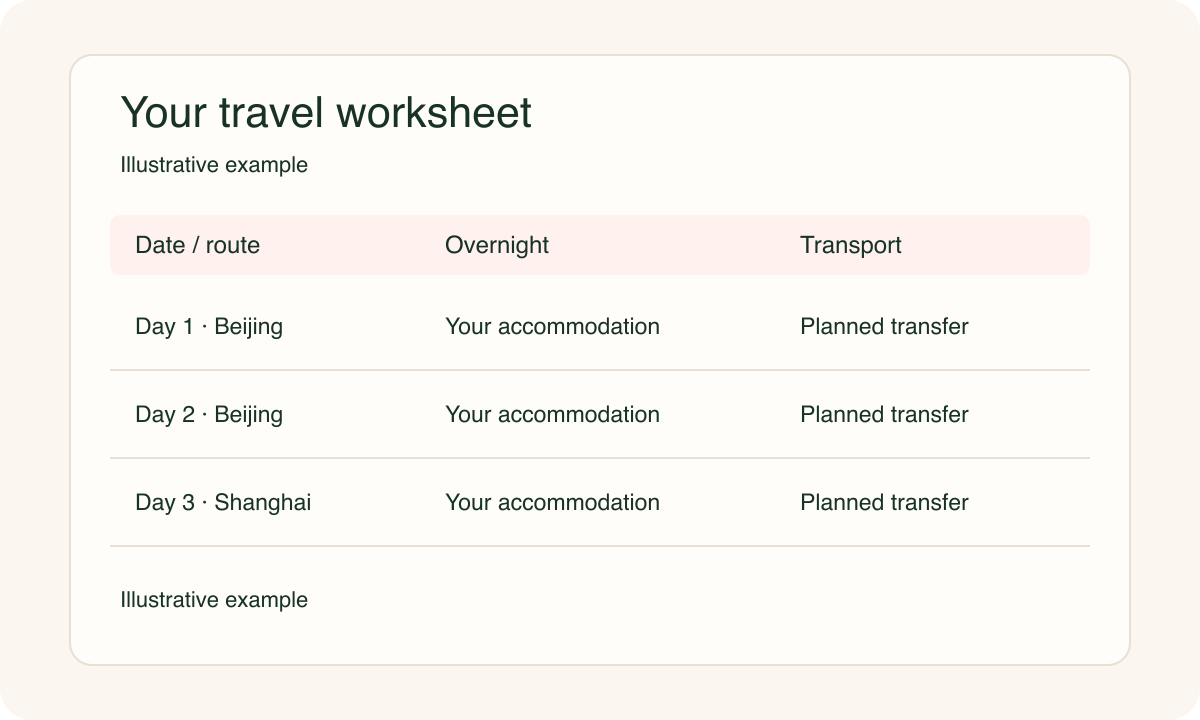
Build your travel worksheet
Choose dates, add your real plans, then export. No account or passport number needed.
Use your actual accommodation details. Leave the last overnight field blank if departing that day. Export before closing or reloading this tab; entries are not saved.
Changes headings, fixed labels and review messages. Your own text stays exactly as entered.
This check flags missing details and cross-border segments. It does not verify bookings, timetables or entry eligibility.
Using this itinerary for a visa application?
Only the US and Cebu L-visa checklists are covered here. Your passport, residence and application location matter; your reading language does not determine eligibility.
For L-visa applications within the US, itinerary, flight/hotel booking and invitation documents are not routine requirements. Individual cases may need additional documents. Official checklist.
Cebu lists itinerary and flight/hotel bookings, or qualifying invitation documents, for online L-visa applications. Check its jurisdiction rules. Fewer paper documents do not mean fewer online uploads. Official checklist.
Check the responsible embassy, consulate or visa centre. This location is not covered. Do not apply the US or Cebu checklist automatically.
Check the entry route separately. A worksheet does not establish eligibility or replace required onward tickets. Visa and entry guide · 240-hour transit checker
Official sources checked 12 November 2026. Recheck before applying.
Use the builder above to turn your own travel plans into a dated worksheet. It creates consecutive daily rows, flags missing overnight stays and transport details, and exports a CSV that opens in Excel, Numbers or Google Sheets. To make a PDF, choose Print / save PDF and select your browser’s PDF destination.
You can also download the blank itinerary CSV without using the builder. No account is needed. Enter real plans and keep booking confirmations separately: an itinerary describes a journey; it does not prove that a flight, room or train is reserved.
Choose the language of your export
CSV and PDF exports default to English. The export-language selector also offers German, Japanese and Spanish headings, fixed labels and review messages. Your own activities, addresses and notes stay exactly as entered; they are not translated. If a recipient needs an English document, check your entered text as well as the headings.
What to put in each row
In each row, record where you plan to be, how you will get there and where you will spend the night.
| Field | Useful detail | What to avoid |
|---|---|---|
| Date | The local calendar date of that travel day | Using your home departure date as the China arrival date when an overnight flight crosses dates |
| City / route | Beijing, or Beijing → Shanghai on a transfer day | Listing a destination without allowing a day to reach it |
| Activities | One main visit plus flexible time nearby | A timetable filled with attractions across different cities |
| Overnight accommodation | Your planned hotel and address, host address, or overnight train / flight | A made-up hotel reservation or an unexplained missing night |
| Transport | The actual booked service, or a clearly marked planned connection | Invented flight numbers or treating a schedule as a ticket |
| Booking status and notes | Which items are reserved and which remain plans | Marking the whole day confirmed when only one item is booked |
Copy accommodation details from the actual property or your reservation. Retain its Chinese name or address when available; that can also help when showing a driver your destination.
Count days and nights separately
Arriving on 1 December and departing on 7 December creates seven calendar days and six intervening nights. A seventh hotel night may be needed if your departure is actually after midnight on 8 December. Use the dates on the real ticket, not the date you expect to leave the hotel.
An overnight train still accounts for a night. Write that in the accommodation field and identify the train as planned or booked in the transport field. The tool flags an empty overnight field, but it cannot know whether a service exists or whether a room booking covers the right dates.
If you change the date range, the builder preserves matching dates in the current tab. It does not save a draft to an account or retain it after you close or reload the page. Export a copy before leaving. The 31-day cap is a worksheet limit, not an allowed stay under any visa or exemption.
A seven-day example: Beijing and Shanghai
This is a planning example, not a reservation or a ready-to-submit visa document. Choose actual dates, accommodation and transport yourself. A seven-day visit with departure on day seven normally has six intervening nights: three in Beijing and three in Shanghai in this example.
| Day | City / route | Planned activity | Overnight |
|---|---|---|---|
| 1 | Beijing | Arrival, hotel transfer, a short neighborhood walk | Your Beijing accommodation |
| 2 | Beijing | One central sightseeing area; check opening days and reservations | Your Beijing accommodation |
| 3 | Beijing | Great Wall outing with a flexible evening | Your Beijing accommodation |
| 4 | Beijing → Shanghai | Intercity travel, hotel transfer, easy evening if time permits | Your Shanghai accommodation |
| 5 | Shanghai | Bund and a nearby neighborhood | Your Shanghai accommodation |
| 6 | Shanghai | One main museum or other chosen visit | Your Shanghai accommodation |
| 7 | Shanghai | Airport transfer and departure | None if departing that day |

Use our China itinerary guide to choose a route before turning it into a document. A short railway journey can still consume much of a day after checkout, station travel, security and check-in at the next hotel. For booking practicalities, see China train tickets for foreigners.
Keep Hong Kong and Macao segments visible
If the trip continues to Hong Kong or Macao, label those days separately. Record the crossing or onward service and the next accommodation. A mainland itinerary should not hide a departure and later return inside a continuous list of Chinese city names. Check the entry permission for each jurisdiction and any later mainland entry independently.
For a 240-hour transit route, a worksheet does not replace the required onward ticket. Shanghai’s official guidance gives the example US → Shanghai → Hong Kong → US and explains that eligible travelers need an onward ticket with a confirmed date and seat. It also says a Shanghai–Hong Kong high-speed rail ticket should be booked in advance for inspection. Entry remains subject to inspection. Official transit guidance.
Use our 240-hour transit checker for that separate question. Selecting “Hong Kong” or “Macao” in this worksheet only triggers a reminder; it does not approve the route.
If you need the itinerary for a visa application
A China tourist visa itinerary is not a universal required attachment. The document checklist for the place accepting your application comes first. Passport nationality, residence and the purpose of travel can affect the application route; this tool does not determine visa eligibility or whether a particular office will accept your application.
For tourist L-visa applications submitted within the United States, the Chinese embassy says round-trip flight booking records, hotel reservations, itineraries and invitation letters are no longer routinely required from 1 January 2024. Applications remain case-specific. Do not buy a template on the assumption that every US application needs one. US embassy notice.
The Chinese Consulate in Cebu lists a different route: upload an itinerary, round-trip airfare and hotel bookings, or qualifying invitation documents. Its April 2026 reduction in physical paperwork does not remove that online upload requirement. Check its jurisdiction and residence conditions before selecting Cebu. Cebu application checklist.
For another application location, read the responsible embassy, consulate or visa centre’s current checklist. We have not verified a universal list for other locations. If you may travel without a visa, start with our visa and entry guide before preparing a visa file.
Review the export against your documents
Before submitting anything, compare the worksheet with your application form and actual supporting documents:
- Arrival and departure dates: include overnight flights and local arrival dates.
- Every intervening night: account for a hotel, host stay or overnight transport.
- Every change of city: allow time to travel and use the correct station or airport.
- Booking status: keep plans distinguishable from supplier-confirmed reservations.
- Names and supporting documents: follow the accepting office’s instructions for identity details, invitation materials and additional evidence.
The automated check only detects missing fields and the entry jurisdictions you select. It cannot verify supplier confirmations, attraction opening days, travel times, proof of funds or the correctness of your visa application. A result with no missing fields is not an approval prediction.
The CSV remains editable after export. It uses UTF-8 and commas. If Excel opens everything in one column, use Data → From Text/CSV, then select UTF-8 and comma as the delimiter. This editor cannot import a saved CSV; continue editing it in your spreadsheet app.
In the PDF print dialog, check the preview and turn off browser headers and footers if you do not want the page URL and print date. An unfinished PDF includes the outstanding review items so they remain visible outside the tool.
Sources and review scope
Official material reviewed 12 November 2026: the US L-visa simplification notice, Cebu visa application checklist and Shanghai transit guidance. The application notes cover those stated contexts only. This is an independent planning tool from China Travel Radar, not an official immigration form or visa service.