Lunar date lookup
Chinese calendar and lunar date converter
Convert Gregorian and Chinese lunar dates in either direction. Check leap months, zodiac and festival dates, then save a result to your calendar.
Today in China uses Beijing time (UTC+8). Calendar downloads save one occurrence. How to use this converter
Festivals
On this page
What year is it in the Chinese calendar?
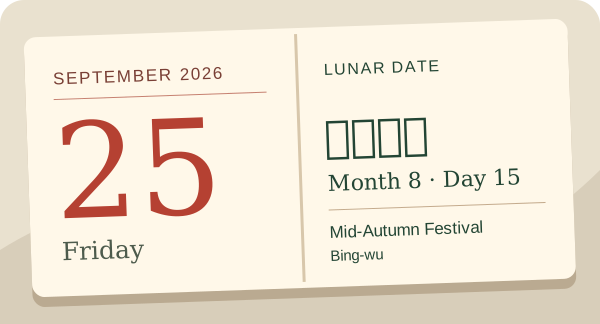
2026 is the Bing-wu Year of the Horse from 17 February 2026 through 5 February 2027. The following Ding-wei Goat year begins on 6 February 2027. The traditional year changes at Chinese New Year, rather than January 1; official civil dates and travel bookings use the Gregorian calendar.
Use the result above for the lunar date of any day you enter. For a complete year, open the Chinese calendar 2026 or Chinese calendar 2027, with every date, festival dates, official mainland holidays and make-up workdays.
If you meant a Chinese baby gender calendar, that is a separate folklore table. Our gender calendar explainer and lookup shows how its age and month inputs work and why it cannot reliably predict a baby’s sex.
How to Convert a Date
- Choose Gregorian → lunar for a Western date, or Lunar → Gregorian for a Chinese lunar date.
- Enter the date. For a lunar date, select Leap month only if the original date belongs to that repeated month; the option is enabled only when it exists in the selected year.
- Read the result above the inputs. Use Copy result link to share it, or Save to calendar (.ics) to download one all-day event.
Supported inputs: Gregorian dates from 19 February 1901 to 31 December 2099, or lunar years 1901–2099. The final months of lunar year 2099 extend into Gregorian 2100; those dates can be entered using the lunar direction.
My local date follows your device. Choose Today in China to use Beijing time (UTC+8). At 5 p.m. in London on 5 February 2027, for example, Beijing is already at 1 a.m. on 6 February, the first day of the Goat year. For a train ticket or hotel booking, enter the date printed on the reservation. The converter keeps that date wherever you open it.
Lunar birthdays and calendar downloads
For a lunar birthday or anniversary, convert the target lunar year each time. Regular and leap months are different months, even when their numbers match. If that leap month does not exist in the target year, the tool cannot choose an alternative birthday observance for you.
The downloaded .ics file saves one occurrence on the Gregorian date shown. Import it into your calendar app; no sign-in is needed here. Do not set it to repeat every Gregorian year, which would keep the Western date fixed instead of following the lunar date.
Chinese Calendar at a Glance
The Chinese calendar is lunisolar: months follow the Moon, while leap months keep the year aligned with the seasons. It determines the dates of festivals such as Chinese New Year and Mid-Autumn, whose Gregorian dates change from year to year.
Chinese New Year is 17 February in 2026 and 6 February in 2027. The lunar years beginning on those dates are the Horse and Goat years respectively. National Day is different: it always falls on 1 October. Check the official holiday schedule separately when planning a trip.
Solar, Lunar, and Lunisolar: Which One Is the Chinese Calendar?
There are three ways a calendar can be built. A solar calendar (like the Gregorian one the West uses) follows Earth’s orbit around the Sun — 365 days, with the seasons locked in place. A purely lunar calendar (like the Islamic Hijri calendar) follows only the Moon’s phases, so its year is about 354 days and drifts backward through the seasons. The Chinese calendar is lunisolar: it counts months by the Moon but keeps the year tied to the Sun.
How a Lunar Month Works
Each lunar month starts on the calendar day of a new moon. The average interval between new moons is about 29.53 days, so a month has 29 or 30 days. These lengths do not have to alternate: the dates of successive new moons determine the month length.
Lantern Festival and Mid-Autumn fall on the 15th day of their lunar months, near the full moon. The astronomical full moon does not necessarily occur on the festival date itself.
Why a Common Year Is Shorter Than a Solar Year
Twelve lunar months add up to roughly 354 days, about 11 days shorter than a solar year. Without adjustment, the same lunar month would move through different seasons over time. The Chinese calendar adds leap months to keep the lunar year aligned with the seasons.
Leap Months: The Calendar’s Self-Correction
To stop the 11-day annual gap from accumulating, the Chinese calendar inserts an extra “leap month” (闰月) every so often. The rule of thumb: roughly 7 leap months are added every 19 years. (This is the same 19-year cycle the ancient Greeks discovered independently — 19 solar years almost exactly equal 235 lunar months.) In a leap year the calendar has 13 months and stretches to about 384 days. The leap month repeats the number of the month before it — so you might get a “fourth month” followed by a “leap fourth month.” For a birthday recorded in a leap month, keep that distinction when converting the original date; how to observe it in other years is a separate personal or family choice.
The 24 Solar Terms (节气)
Running underneath the lunar months is a purely solar framework: the 24 solar terms, which divide the Sun’s annual path into 24 equal segments of about 15 days each. These terms — names like Start of Spring (立春), Grain Rain (谷雨), and Winter Solstice (冬至) — were the farmer’s almanac of ancient China, signaling when to plant, harvest, and prepare for cold. They’re the “solar” half of “lunisolar,” and they’re fixed to the Gregorian calendar within a day or two every year, unlike the lunar festivals.
| Season | Example solar terms | Approx. Gregorian window |
|---|---|---|
| Spring | Start of Spring, Awakening of Insects, Qingming | early Feb – early May |
| Summer | Start of Summer, Summer Solstice, Great Heat | early May – early Aug |
| Autumn | Start of Autumn, White Dew, Cold Dew | early Aug – early Nov |
| Winter | Start of Winter, Winter Solstice, Great Cold | early Nov – early Feb |
The Sexagenary Cycle: 60 Years, Not 12
The sexagenary cycle names each year by combining 10 Heavenly Stems (天干) and 12 Earthly Branches (地支). Because 10 and 12 share a common factor, the stems and branches pair up in a repeating sequence that takes 60 years to return to the start. Each year carries a stem-branch name (the widget above shows yours) — 2026 is bǐngwǔ (丙午). Each Earthly Branch corresponds to one of the 12 zodiac animals. The animal cycle repeats every 12 years, while the stem-branch combination repeats every 60.
The Zodiac Year and What Animal You Are
The 12 zodiac animals — Rat, Ox, Tiger, Rabbit, Dragon, Snake, Horse, Goat, Monkey, Rooster, Dog, Pig — cycle one per year. 2026 is the Year of the Horse; 2027 is the Year of the Goat. This converter starts the zodiac year on Chinese New Year, not January 1. So a baby born in late January or early February might belong to the previous year’s animal — the widget above resolves this automatically by converting to the true lunar date. (For a deeper dive, see our Chinese zodiac calculator.)
Why Festival Dates Move Every Western Year
Most major Chinese festivals are pinned to a fixed lunar date (e.g., “the 5th day of the 5th lunar month”). Since the lunar year is ~11 days shorter than the solar year, that fixed lunar date lands on a different Gregorian date annually — usually drifting earlier each year until a leap month resets it later. That’s why Chinese New Year falls in January or February, and why you can never assume “last year’s date” will work for planning.
Major Festivals at a Glance (2026 & 2027)
Note that Qingming is the exception: it’s tied to a solar term, so it sits on April 4–5 almost every year, while the lunar festivals jump around.
| Festival | Lunar date | 2026 (Gregorian) | 2027 (Gregorian) |
|---|---|---|---|
| Spring Festival (Chinese New Year) | 1st day, 1st month | Feb 17 | Feb 6 |
| Lantern Festival | 15th day, 1st month | Mar 3 | Feb 20 |
| Qingming (Tomb-Sweeping) — solar term | ~solar term | Apr 5 | Apr 5 |
| Dragon Boat (Duanwu) | 5th day, 5th month | Jun 19 | Jun 9 |
| Qixi (Chinese Valentine’s) | 7th day, 7th month | Aug 19 | Aug 8 |
| Mid-Autumn (Mooncake) | 15th day, 8th month | Sep 25 | Sep 15 |
| Double Ninth (Chongyang) | 9th day, 9th month | Oct 18 | Oct 8 |
The Traveler’s Angle: Crowds That Move Each Year
The lunar date tells you when the festival falls; the State Council calendar tells you how long the public holiday lasts. For the current break, transport pressure and city choices, use the Mid-Autumn Festival 2026 travel guide.
Spring Festival and Mid-Autumn move on the Gregorian calendar because they follow lunar dates. National Day stays on 1 October; the surrounding public holiday and any overlap with Mid-Autumn depend on the official schedule for that year. Festival dates alone do not tell you the length of a holiday or which days are working days.
Check both the festival date and the announced holiday arrangements before booking transport and accommodation. Our best time to visit China guide adds a month-by-month view of weather and travel conditions.
Is the Calendar Still Used Today?
China uses the Gregorian calendar for government and business. The traditional calendar remains in use for lunar festivals, birthdays and cultural customs. Some people also consult a traditional almanac to choose auspicious dates; this converter provides date conversions, not auspicious-day advice.
Data and Sources
The converter uses a bundled year table and runs in your browser. We checked both conversion directions for all 1,095 dates in 2025–2027 against the Hong Kong Observatory’s daily calendar data on 27 October 2026. This check does not cover every year in the supported range.